

Warehouse CCTV covers dock doors, yards, aisles, shipping and receiving counters and high-value inventory zones using 4K IP cameras on Cat6A PoE cabling, recorded to an on-site NVR. It differs from office CCTV because sight lines are longer, lighting is uneven and the highest-risk activity happens at the dock and fence line.
Velocity Cabling designs and installs warehouse CCTV systems for distribution centres, 3PL facilities, manufacturing warehouses, transportation yards and industrial buildings throughout Toronto and the GTA. We build security systems around how a warehouse actually operates: dock turnover, forklift traffic, trailer movement, employee entrances, inventory risk, after-hours access and safety announcements. Because we are a full low-voltage contractor, we can deliver cameras, structured cabling, paging systems, access control and backbone upgrades as one integrated scope.
Why Warehouse CCTV Is Different From Standard Business CCTV
Warehouses create security challenges that do not exist in a typical office or storefront. Ceiling heights are greater, aisle widths are longer, lighting varies by zone, shipping areas create constant movement and the consequences of a blind spot are higher. A warehouse camera system has to capture usable detail at loading docks, watch yard activity after hours, monitor high-value inventory movement and give operations teams evidence when claims or disputes arise.
Longer Sight Lines
Warehouse aisles, shipping lanes and perimeter runs demand better optics, stronger low-light performance and more careful camera positioning than standard office environments.
PoE Infrastructure
Professional warehouse CCTV relies on structured Cat6A or fiber-supported backbone infrastructure, not consumer wireless devices that fail under scale and interference.
Dock and Yard Exposure
Most warehouse incidents happen near dock doors, man doors, parking, trailer staging and fence lines. These zones need dedicated design, not leftover cameras pointed in the general direction.
Evidence and Operations
A strong warehouse system supports both security and operations by helping verify shipments, investigate damage claims, review traffic patterns and monitor compliance in key zones.
Warehouse CCTV Coverage Zones We Commonly Design For
The zones that matter most are dock doors, shipping and receiving counters, main aisle intersections, high-value inventory cages, the yard and fence line, and employee entrances. Most warehouse incidents happen at the dock or the perimeter, not deep in the racking.
Every warehouse has different risks, but the same core zones appear on most GTA projects. We map the coverage objective first, then choose the right camera type and infrastructure for that objective.
| Zone | Typical Camera | Primary Objective | Priority |
|---|---|---|---|
| Each loading dock door | 4K dome or bullet | Capture trailer arrivals, driver activity, cargo handling and timestamps | Critical |
| Shipping and receiving counters | 4K fixed camera | Verify parcel handoff, paperwork disputes and package condition | Critical |
| Main aisle intersections | Wide-angle or fisheye | Monitor cross-traffic, safety incidents and blind spot movement | Critical |
| Inventory cages and high-value stock | 4K close-detail camera | Record handling, shrinkage exposure and restricted-area access | Critical |
| Yard, fence line and gates | PTZ, bullet or specialty camera | Watch perimeter intrusion, vehicle movement and after-hours activity | High |
| Employee entrances and man doors | Face-level camera | Document access, tailgating and entry-exit events | High |
| Parking and trailer staging | Outdoor overview camera | Capture vehicle circulation and overnight yard security | High |
| Network room and security rack | Fixed indoor camera | Protect NVR, switches and other low-voltage infrastructure | Medium |
Camera Types and System Components For Warehouse Environments
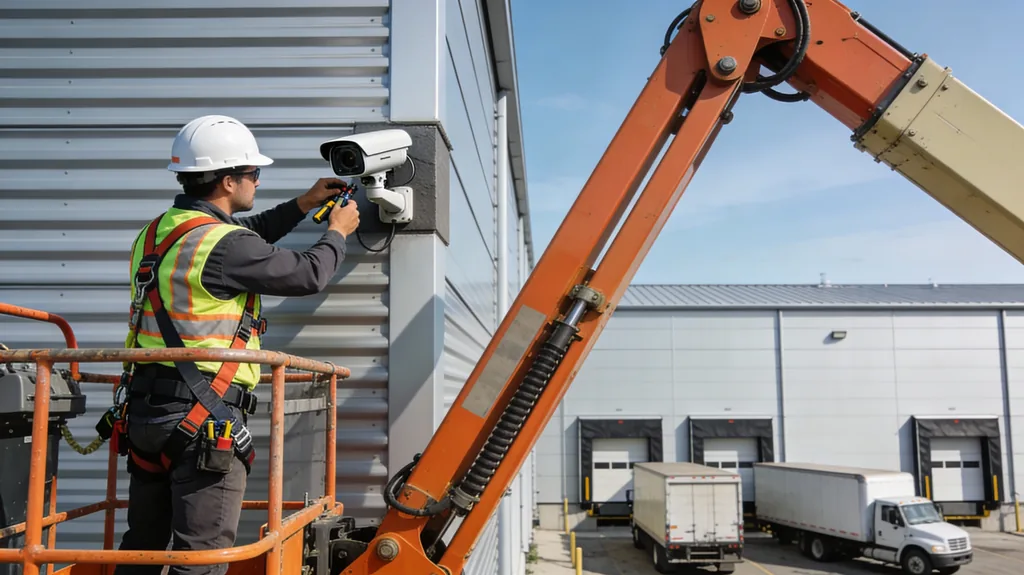

We do not force one hardware type into every zone. The right warehouse design usually mixes several camera categories with the proper switching, storage and cabling infrastructure behind them.
Core interior camera for aisles, dock aprons, production support zones and receiving areas where you need reliable detail and a durable, tamper-resistant housing.
Ideal for larger yards, trailer compounds and long exterior runs where operators need flexible zoom and active incident follow-up.
Useful at major intersections, open floor spaces and high-bay zones where fewer mounts can still provide broad situational awareness.
Provides data and power to warehouse IP cameras, typically from MDF or IDF locations, with uplinks sized to support high camera counts and retention targets.
Recording, storage management, playback, remote access and user permissions configured around your retention policy and operational needs.
Structured cabling that supports powered cameras, specialty devices and future warehouse technology upgrades without redoing the security infrastructure.
Warehouse Paging Systems: Announcements, Safety and Operations
Warehouse paging uses high-SPL horn speakers on a zoned amplifier so announcements stay intelligible over forklift, conveyor and HVAC noise that typically runs 80–90 dB. Cabling it alongside the CCTV means one set of pulls, one tray and one contractor rather than two trades in the same ceiling.
Many warehouses need more than cameras. Overhead paging systems help supervisors make zone-wide announcements, call shipping teams to active docks, issue safety notices and communicate across noisy production or logistics environments. When CCTV and paging are installed together, the result is a cleaner and more coordinated facility-wide communication and security system.
Operational Announcements
Call forklift operators, receiving teams or pick-and-pack staff to a specific zone without relying on cell phones or walking the floor.
Emergency Messaging
Deliver evacuation or incident messaging quickly in large facilities where visual communication alone is not enough.
One Coordinated Scope
Bundling CCTV, paging and cabling reduces duplicate lift rentals, repeated site disruption and finger-pointing between trades.
Future Expansion
We design paging infrastructure with room for additional speakers, zones or controller changes as your warehouse grows or reconfigures.
If you need dedicated paging coverage, we can also build that scope around our paging system installation service and coordinate it with the warehouse camera design from the start.
Integrated Warehouse Security Systems: CCTV, Access Control and Cabling
Warehouse security works best when cameras are not treated as a standalone purchase. Most clients also need controlled door access, structured cabling upgrades, gate or man-door coverage and sometimes fiber or electrical support for remote zones. We coordinate these systems so the infrastructure is planned once and installed once.
Access Control Integration
We can align cameras with warehouse entries, staff doors and restricted inventory zones, and coordinate the project with our access control installations.
Cat6A and Fiber Infrastructure
Security performance depends on the network underneath it. We install Cat6A cabling and fiber optic backbone links for larger warehouse and distribution environments.
Paging Systems In The Same Install Window
When paging is part of the plan, speaker zones, controller locations and cable routes are coordinated with the CCTV scope rather than retrofitted later.
Minimal Operational Disruption
One planned security project is easier on active warehouse operations than multiple contractors revisiting the same lift zones, ceiling spaces and telecom rooms.
What Our Warehouse CCTV Projects Typically Include
Onsite Survey and Coverage Planning
We review dock count, entry points, aisle geometry, rack layout, yard exposure and telecom room locations before finalizing camera positions or infrastructure requirements.
Cabling, Switching and Uplink Planning
Each camera drop, switch location and backbone uplink is designed so the system can scale cleanly and support the resolution and retention targets you actually need.
Commercial Camera Mounting and Commissioning
We supply, install, aim and commission cameras for the exact zone objective instead of handing over default factory settings and generic fields of view.
Paging System Coordination
If your warehouse needs overhead paging, we coordinate speaker placement, amplifier or controller locations and announcement zones with the rest of the security infrastructure.
Training, Handover and Support Notes
Your team receives system orientation, user-access setup, camera schedules and enough documentation to manage the system properly after turnover.
Our Warehouse Security Installation Process
Survey the Facility
We review operations, traffic flow, current blind spots, telecom locations, dock count and whether the project includes CCTV only or CCTV plus paging and access control.
Build the System Scope
We define coverage zones, camera counts, cabling routes, recording requirements and any integrated low-voltage systems needed for the facility.
Coordinate Install Timing
For active warehouses, we plan around receiving windows, production schedules and lift access so critical operations stay moving.
Install Infrastructure and Devices
We complete the cable pathway, pulls, terminations, camera mounting, rack work, paging devices and any related low-voltage scope.
Commission and Verify
Recording, remote access, user roles, camera views and announcement zones are tested before handover so the system is usable on day one.
Handover the Project
We walk the client through the system, provide the relevant documentation and leave the warehouse with a finished, operational low-voltage scope.
Warehouse CCTV Service Areas Across Toronto and the GTA
We focus on commercial and industrial properties throughout the GTA warehouse belt. This includes older infill facilities, large-format distribution buildings and multi-tenant industrial complexes.
Toronto and Etobicoke
Urban logistics sites, last-mile depots, food distribution, manufacturing support and older industrial stock that often needs security upgrades plus backbone improvements.
Mississauga and Brampton
One of the busiest freight and warehousing corridors in the country, with heavy demand for dock cameras, yard surveillance, trailer oversight and paging for large floorplates.
Vaughan and North GTA
High-growth industrial parks along the 400 and 407 corridors where clients often need integrated camera, access and cabling scopes.
Bolton, Caledon and Surrounding Cities
Growing warehouse and yard locations where large sites, outdoor exposure and distributed building footprints make proper surveillance planning especially important.
Frequently Asked Questions
Reviewed October 2026 · Velocity Cabling · Toronto & GTA