
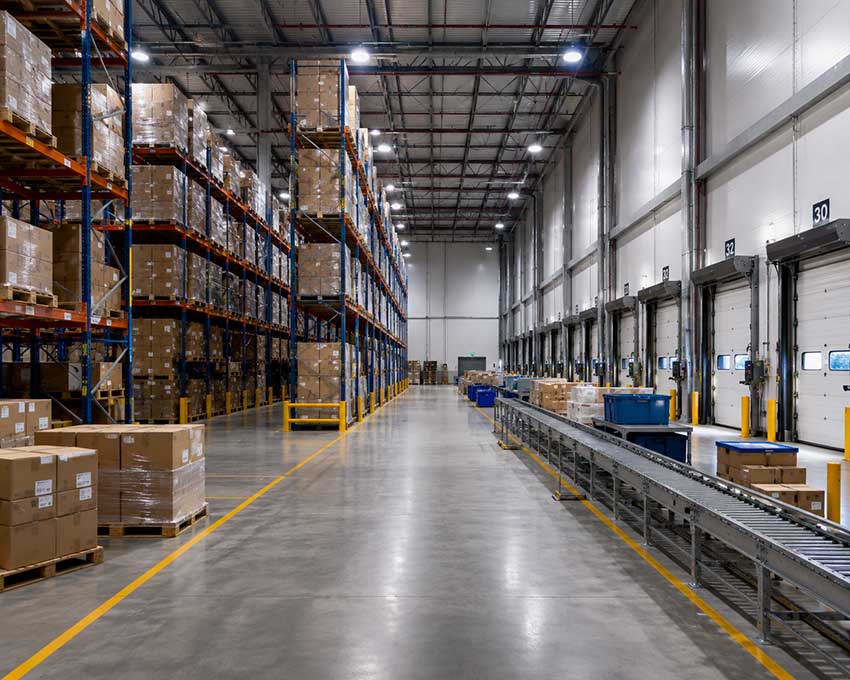
Cable Tray Installation Toronto
Ladder, basket and solid-bottom tray for warehouses, plant floors and offices. Sized for your whole low-voltage scope, not just today's cable count — and installed by the same crew that pulls the cable.
Pathway Decides What You Can Do Later
Cable tray is the least glamorous line on a cabling quote and the one that determines what the building costs you for the next decade. Get it right and adding thirty drops is an afternoon. Get it wrong and every future change means new pathway, which means ceilings open and areas out of service.
The mistake we are called in to fix is almost always the same: tray sized for the cable being installed that week, with no allowance for the cameras, access control and wireless that arrive over the following two years. By then it is full, and the cheap decision has become an expensive one.
Which Tray Type For Which Job
| Type | Best for | Trade-off |
|---|---|---|
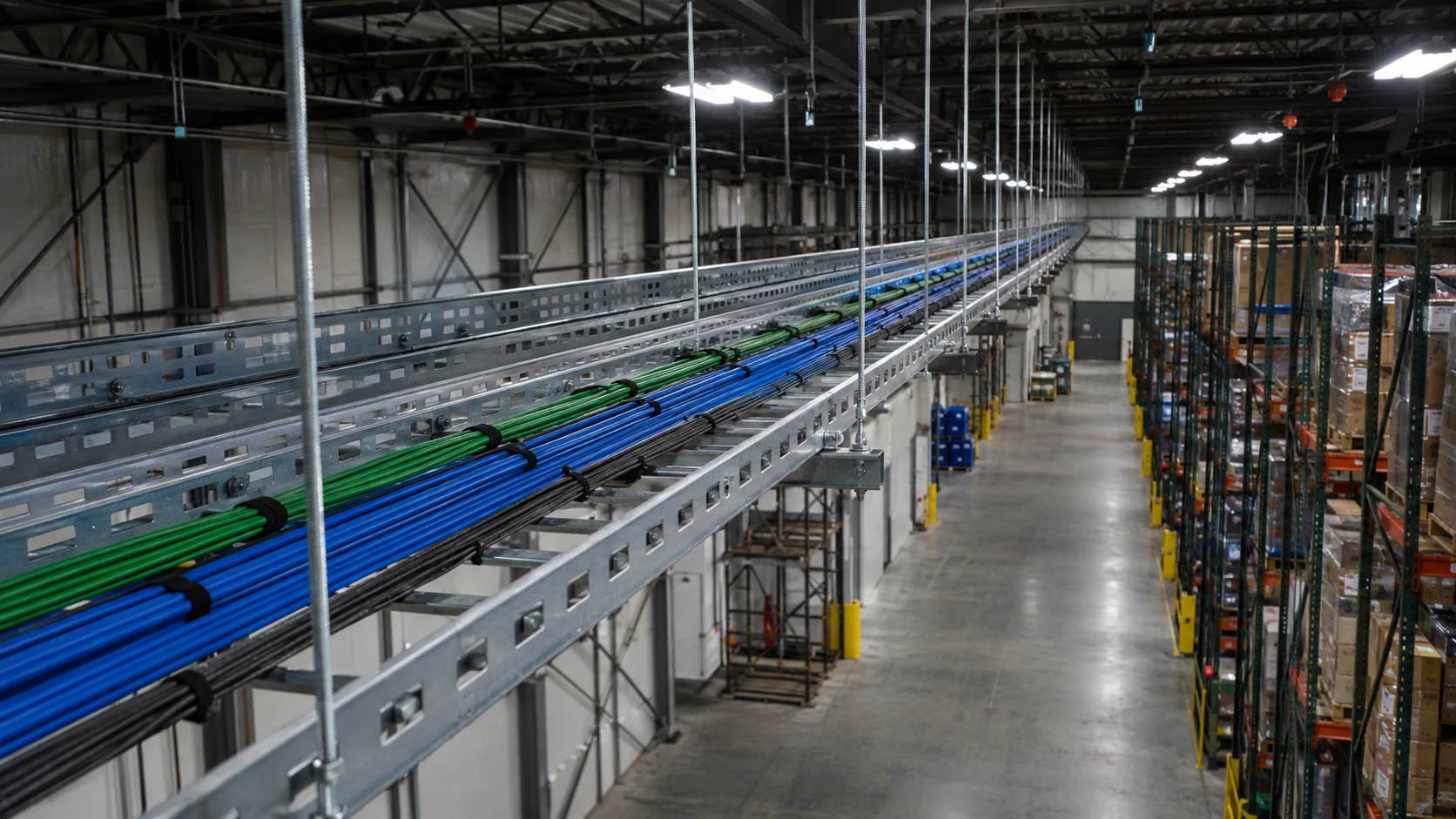
| Ladder | Long straight high-bay runs, heavy bundles, warehouses and plant floors | Drop-outs only at rungs; heavier to install |
| Wire basket | Offices, above suspended ceilings, lighter loads, frequent changes | Lower load capacity; needs more support points |
| Solid bottom | Dusty or wet areas, physical protection, EMI-sensitive routes | Traps heat and dirt; hardest to add to later |
| J-hooks | Under 20 cables on a short route | No growth path; concentrates weight; messy at scale |
Most GTA commercial projects end up with a mix: ladder through the warehouse or riser, basket above the office ceiling where drop-outs happen everywhere.
Four Things A Good Tray Scope Accounts For
Around 40 percent working fill for communications cable, with deliberate spare capacity beyond it. Overfilled tray traps heat and crushes the bottom of the bundle.
Support intervals come from the manufacturer's load tables for the tray class and span, not from where the steel happens to be convenient.
Low-voltage kept clear of power wiring, with proper spacing on parallel runs and correct crossing angles. Code requirement and noise control in one.
Metallic tray bonded with continuity maintained across every splice and expansion joint — routinely missed where sections were added later.
Cat6A changes the maths. Cat6A is roughly 7.5mm against Cat6's 5.8mm, about 65 percent more cross-section per cable. Tray sized for a Cat6 count will not take the same number of Cat6A runs. On retrofits this is usually the constraint that drives cost, and it is the first thing we measure.
Where Tray Earns Its Cost
Warehouses and distribution
High-bay runs feeding scan stations, cameras and dense AP coverage. Long spans where J-hooks are simply not an option.
Plant floors and industrial
Where cable needs protecting from equipment, forklifts and washdown, and where separation from motor drives matters.
Multi-tenant office floors
Basket above the ceiling turns every future tenant fit-out into a cable pull instead of a pathway project.
Server rooms and MDF
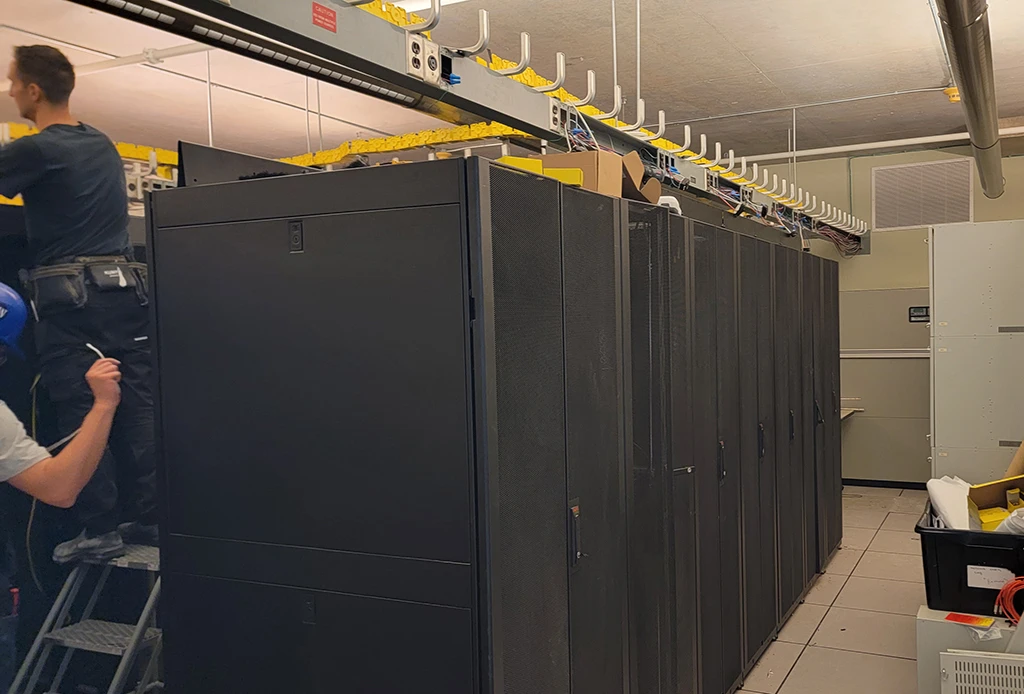
Overhead tray keeps runs off the floor and out of airflow paths. Pairs with data centre cabling.
Tray And Cable, One Contract
Buying pathway separately from cabling is how tray ends up the wrong size. We install both, so the tray gets sized for the full low voltage scope — data, cameras, access control, paging and fiber — rather than for whichever system happens to be first.
Cable Tray: Common Questions
Roughly once you pass 20 to 30 cables on a common route, or whenever you expect to add more later. J-hooks are quick and cheap for a handful of runs, but they concentrate weight, make additions messy and give you nowhere to grow. Tray costs more up front and less every time you touch the building afterwards.
For communications cable the usual working figure is around 40 percent fill, and we design to leave room beyond that. Overfilled tray traps heat, crushes the cables at the bottom of the bundle and makes future work miserable. The governing limits come from the Canadian Electrical Code and the manufacturer load tables, so the final number depends on tray type, cable and application.
Ladder tray for long straight high-bay runs with heavy bundles. Wire basket for offices and lighter loads where you need to drop out anywhere along the run. Solid bottom where cables need physical protection or shielding from contamination. Most GTA commercial projects end up ladder in the warehouse and basket above the office ceiling.
Metallic tray is generally required to be bonded, with continuity maintained across every splice and expansion joint. It is routinely missed on retrofits where sections were added later without bonding jumpers. We verify continuity across the run rather than assuming the splice plates did the job.
Yes, and most of our tray work is in live buildings. Overhead work is scheduled for evenings or weekends, areas are isolated, and we coordinate access with your operations team so aisles and workstations stay usable during business hours.
That is the usual reason to hire us for it. We install the pathway and pull, terminate and certify the cable in it as one contract, so tray gets sized for the whole low-voltage scope rather than for one system and then found to be full.
Last reviewed 12 August 2026. Fill limits, support spacing and bonding are governed by the CEC, manufacturer load tables and the authority having jurisdiction.
From First Call To Certified Handover.
Five steps, same order, every job. You always know what happens next and who is on site.
Free Onsite Survey
We walk your space, document cable routes and flag every constraint. No cost, no obligation.
Written Proposal
Itemized quote covering materials, labour, timeline and compliance standard.
Pre-Install Planning
We coordinate with your PM, GC or IT team. Rack layouts and phasing locked before day one.
Expert Installation
Our installers pull, dress, terminate and label every run to your spec.
Test & Certify
Every run Fluke tested. We don't leave until every port passes.

Pathway Sized For What Comes Next.
Free onsite survey within 48 hours. We measure what is there, count what is in it, and tell you what fits.
Mon–Fri 8am–10pm · Evening & weekend installs available · Toronto, GTA & Southern Ontario