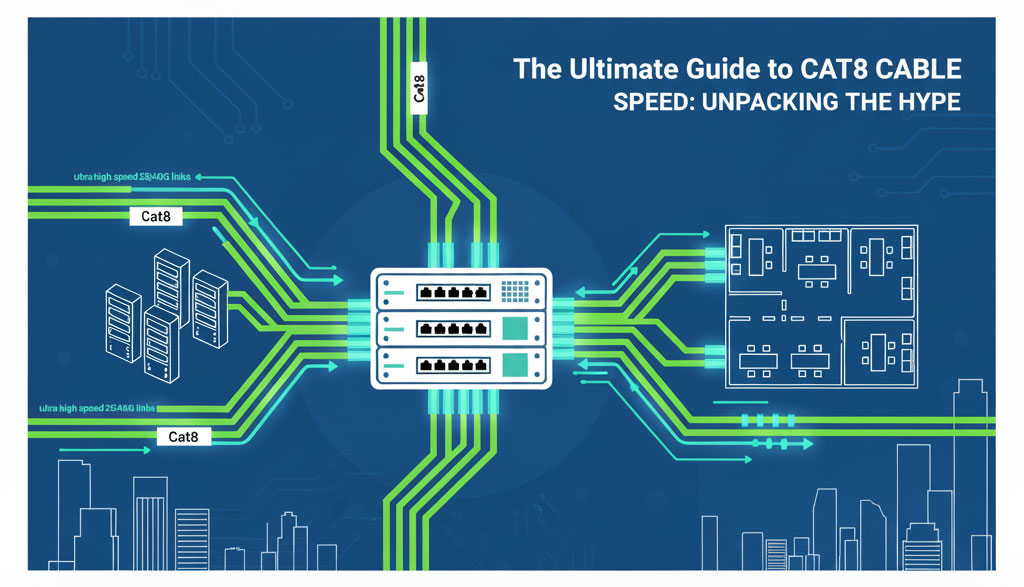
The Ultimate Guide to Cat8 Cable Speed: Unpacking the Hype
You’ve heard the headline: Cat8 network cable can handle 40 Gigabits per second (Gbps). That’s four times faster than the Cat6a in your office walls and over 400 times faster than a typical home internet connection. It sounds like science fiction made real—a simple copper cable moving data at breathtaking rates.
But what does that staggering number actually mean for you? Is it a future-proof investment or a case of serious overkill? This guide cuts through the marketing to give you a technically sound, simple-to-understand breakdown of everything about Cat8 speed. We’ll cover not just the “what,” but the “how,” the “where,” and the crucial “why not.”
The Technical Foundation: How Cat8 Achieves 40 Gbps
The speed of any Ethernet cable is a function of two key engineering feats: Bandwidth and Signal Integrity.
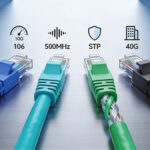
- Bandwidth (The Highway’s Lanes): Think of bandwidth as the number of lanes on a data highway. Cat8 operates at a massive 2000 MHz (2 GHz) frequency. Compare this to Cat6a’s 500 MHz or Cat5e’s 100 MHz. This enormous bandwidth allows it to carry vastly more data signals simultaneously without them crashing into each other.
- Signal Integrity (The Smoothness of the Road): At such high frequencies, the electrical signals are incredibly fragile. They are susceptible to external interference (EMI/RFI from power cables, fluorescent lights) and internal interference (crosstalk) from the other pairs in the same cable.
- Cat8’s Solution: Radical Shielding. Every Cat8 cable is fully shielded. The most common and recommended type is S/FTP:
- S (Shielded overall): A braided metal mesh around the entire set of pairs.
- F (Foiled pairs): Each of the four twisted pairs is individually wrapped in a foil shield.
- This fortress-like protection preserves the purity of the 40 Gbps signal, which would degrade into nonsense in an unshielded (UTP) environment.
- Cat8’s Solution: Radical Shielding. Every Cat8 cable is fully shielded. The most common and recommended type is S/FTP:
The Standard Behind the Speed: This performance is formalized in the IEEE 802.3bq 40GBASE-T standard. It defines precisely how to use all four cable pairs with advanced modulation to achieve 40 Gbps over copper.
The Critical Catch: Speed is Distance-Limited
This is the single most important fact about Cat8 Cabling speed that most articles miss. The 40 Gbps rating is not unlimited.
- Maximum Channel Length: 30 meters (≈98 feet).
- Maximum Permanent Link (in-wall) Length: 24 meters (≈79 feet).
Why? Physics. At 2000 MHz, electrical signals in copper attenuate (weaken) very quickly. Beyond 30 meters, the signal degrades too much for the receiving equipment to accurately interpret it as 40 Gbps data. The standard is built around this hard limit.
The Simple Comparison:
| Cable Category | Max Bandwidth | Max Data Rate (at full length) | Effective Top Speed Distance |
|---|---|---|---|
| Cat8 | 2000 MHz | 40 Gbps | Up to 30m |
| Cat6a | 500 MHz | 10 Gbps | Up to 100m |
| Cat6 | 250 MHz | 1 Gbps (10Gbps to 55m) | Up to 100m |
Key Takeaway: Cat8 isn’t a “better” Cat6a. It’s a short-range, ultra-high-speed specialist. If you need 10 Gbps runs longer than 30m, Cat6a or Cat7 is still your only choice.
Real-World Factors That Affect Actual Speed
Your Cat8 cable won’t magically give you a 40 Gbps internet connection. Here’s what dictates your actual speed:
- Your Network Equipment: You need a 40GBASE-T switch (NIC card) on both ends of the cable. These are expensive, power-hungry, and primarily found in high-end data center switches and servers. Most desktop PCs and consumer routers have 1 Gbps (Gigabit) ports. Some have 2.5Gbps or 10Gbps. Your speed is limited by the slowest device in the chain.
- The Quality of Installation: Cat8 is unforgiving. Poor termination—where even a tiny bit of the shield or untwist is exposed—can create signal reflections that cripple performance. It requires skilled installation and proper, certified Cat8 keystone jacks and patch panels.
- Cable Quality: Not all “Cat8” on the market is true, standards-compliant Cat8. Look for reputable brands and certification to ANSI/TIA-568-C.2-1.
Where Cat8’s 40Gbps Speed Actually Makes Sense
Given its cost and constraints, here are the practical applications:
- Data Center Top-of-Rack (ToR) Connections: Connecting a server directly to a nearby switch within a single server rack. The short distances are perfect.
- High-Performance Computing (HPC) Clusters: Linking adjacent computing nodes that need to exchange massive datasets with ultra-low latency.
- Professional Audio/Video and Broadcasting Studios: Moving uncompressed 8K+ video streams between equipment bays.
- Network Backbone Links within a controlled equipment room (e.g., between core and aggregation switches placed close together).
Where Cat8 Speed is Overkill (The “Why Not”)
- Home Networking: Almost always. Your internet speed, NAS, and PCs won’t saturate a 10 Gbps (Cat6a) link, let alone 40 Gbps.
- General Office Networking: Standard office traffic doesn’t require this bandwidth. Cat6 or Cat6a is the cost-effective, 100m-capable choice.
- Long-Distance Runs: Any run over 30m immediately disqualifies Cat8 from providing its rated speed.
- Gaming: The latency difference between a good Cat6a and Cat8 is measured in microseconds, imperceptible to humans. Game performance is dictated by your internet, GPU, and monitor.
Busting the Big Cat8 Speed Myths
❌ Myth: “Cat8 gives me faster internet.”
✅ Truth: Your internet speed is set by your ISP plan. Cat8 cannot make a 100 Mbps plan any faster.
❌ Myth: “I need Cat8 for 10 Gbps networking.”
✅ Truth: Cat6a supports 10 Gbps up to 100 meters. It is the standard for 10GBASE-T and is more flexible and cheaper than Cat8 for this purpose.
❌ Myth: “Cat8 is the latest, so it’s always the best.”
✅ Truth: It’s the best for a specific job (short-range 25G/40G links). For the vast majority of applications, Cat6a is the better, more practical “best.”
The Strategic Truth About Cat8 Speed
Cat8 is a precision tool, not a universal upgrade.
Its 40 Gbps capability is a marvel of copper engineering, made possible by huge 2000 MHz bandwidth and extreme shielding. However, it comes with a strict 30-meter distance leash and requires expensive, compatible hardware.
Should you use it?
- Yes, if you are designing a data center, HPC cluster, or specialized AV setup with equipment supporting 40GBASE-T and runs under 30m.
- No, if you are a home user, gamer, or business looking for general “future-proofing.” For these scenarios, investing in a well-installed Cat6a system provides 10 Gbps capability up to 100m, which will be more than sufficient for the next decade, at a fraction of the cost and complexity.
Cat8’s speed is real, but its reign is purposefully confined. Understanding that purpose is the key to making a smart cabling investment.