
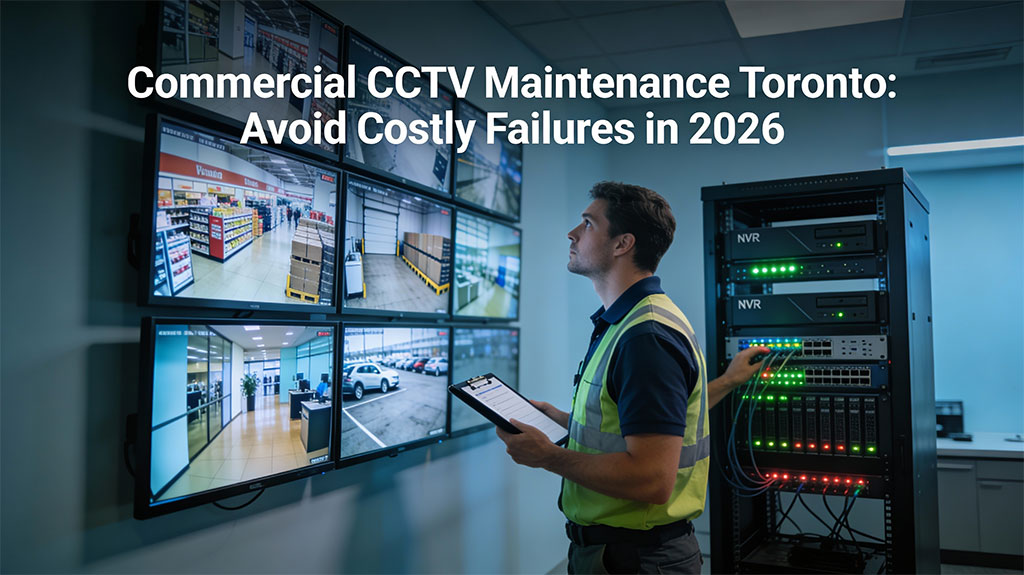
Commercial CCTV Maintenance Toronto – 2026 Guide
For Toronto and GTA-based businesses, a Commercial Closed-Circuit Television (CCTV) system is a critical component of risk management—covering security, liability, and operational oversight. However, most organizations treat it as a static “install and forget” asset. This is a fundamental engineering and operational error. In 2026, with systems growing in complexity (IP-based, integrated with analytics, reliant on network infrastructure), a systematic maintenance regimen is not an optional service; it is the primary defense against catastrophic system failure, evidential loss, and costly emergency repairs. This guide establishes a proactive maintenance framework rooted in the principles of systems engineering and tailored to the unique environmental stressors of the Greater Toronto Area.
Why CCTV Maintenance Matters in 2026
Improperly maintained CCTV systems often fail exactly when you need evidence—during theft, accidents, or HR incidents. Typical issues are blurry images, offline cameras, corrupted recordings, or missing days of footage due to storage misconfigurations.
In Toronto and the GTA, commercial sites must also think about:
Liability and insurance: Insurers increasingly expect working video evidence after incidents.
Compliance and investigations: Usable, time-stamped footage supports police and internal investigations for retail, offices, warehouses, and industrial sites.
Well-maintained systems last longer, reduce emergency service calls, and deliver a much better ROI on the original camera and cabling investment.
Commercial CCTV Maintenance
Commercial CCTV systems are critical infrastructure, not commodities. This guide details a systematic, proactive maintenance framework tailored to Toronto’s environment to prevent the cascade of failures that compromise security and incur major costs.
The Failure Economics of Neglect
Understanding the cost of failure is the first step in justifying maintenance investment.
1.1 The Direct Cost Cascade:
Hardware Failure: A single failed PTZ camera can cost $1,500-$4,000+ to replace, not including labour.
Emergency Service Premiums: After-hours troubleshooting and repair commands rates 50-100% higher than scheduled service.
Secondary Infrastructure Damage: A failed PoE switch port can cascade to multiple cameras; water ingress can damage structural cabling.
Data Loss & Forensic Recovery: Critical footage lost during an incident (theft, accident, liability claim) has intangible but severe financial and legal consequences.
1.2 The Intangible Risk Exposure:
Security Vulnerability: Blind spots during a break-in.
Compliance Breaches: Industries like cannabis retail, logistics warehouses, and financial services have regulatory mandates for recorded surveillance. System downtime can result in fines.
Reputational Damage: For property managers and building owners, a demonstrably faulty security system impacts tenant retention and leasing potential.
Conclusion: A planned annual maintenance investment of 5-15% of the system’s initial value prevents costs that are often 10-100x greater when failure occurs.
A CCTV system is only as strong as its weakest link. The analysis demonstrates that failure is not random but a predictable consequence of environmental stress and component wear. Therefore, effective maintenance cannot be generic; it must be a component-specific, proactive strategy. This means moving beyond simple “check if it’s on” verification to implementing technical diagnostics—such as measuring PoE voltage under load and conducting data integrity audits—tailored to each subsystem’s role and risk profile. By addressing the unique vulnerabilities of the edge, conduit, and core with the prescribed protocols, you transform maintenance from a cost into a strategic investment, ensuring the entire chain of components functions as a reliable, coherent security asset.
System Component Analysis & Failure Modes
A CCTV system is a chain of components; maintenance must address each link.
2.1 The Edge: Cameras & Housings (The Most Exposed Elements)
Primary Stressors (GTA Specific): Thermal cycling (-30°C to +35°C), road salt aerosol, pollution, moisture/ice accumulation, high winds.
Common Failure Modes:
Lens Occlusion: Dirt, salt film, spider webs, internal condensation. Effect: Blurry or obscured footage.
IR Cut Filter Failure: In day/night cameras, the mechanical filter that switches for IR mode sticks. Effect: Colour distortion during day, poor night vision.
Heater/Blower Failure in Environmental Housings: Critical for outdoor dome cameras to prevent frost/condensation. Effect: Complete lens icing in winter.
PTZ Mechanism Degradation: Grease stiffens, gears wear, motors fail. Effect: Loss of pan, tilt, or zoom function; the camera is stuck.
Maintenance Protocol: Quarterly visual inspection (remotely or on-site), biannual physical cleaning of housings and lenses with appropriate solvents, functional test of heaters/blowers before winter.
2.2 The Conduit: Cabling & Connectivity (The Hidden Vulnerability)
Primary Stressors: Rodent activity, water ingress in conduits, corrosion at connections, physical stress from wind or building movement.
Critical Focus: Power over Ethernet (PoE) Health.
Problem: PoE delivers both data and power. A degrading cable or connector increases electrical resistance, causing voltage drop.
Symptom: Camera randomly reboots, especially in cold weather when PoE heaters draw more current. This is a progressive failure.
Diagnosis: Requires a cable qualification test (e.g., Fluke DSX) measuring DC Loop Resistance and Resistance Unbalance, not just data continuity.
Maintenance Protocol: Annual inspection of cable entry points, junction boxes, and patch panels for corrosion. Use a network analyzer to check PoE voltage at the camera end during peak load (e.g., heater on).
2.3 The Core: Network & Storage Infrastructure
Primary Stressors: 24/7 read/write cycles, network congestion, firmware obsolescence, power surges.
Common Failure Modes:
Network Switch PoE Budget Exhaustion: As cameras are added or upgraded, the total wattage demand can exceed the switch’s capacity, causing intermittent shutdowns.
Storage Drive Failure: NVR/VMS storage drives (HDDs) have a finite Mean Time Between Failure (MTBF). Running at high temperatures in poorly ventilated racks accelerates failure.
Firmware/Software Vulnerabilities: Unpatched systems are exposed to cybersecurity threats and software glitches.
Maintenance Protocol:
Quarterly: Verify switch PoE utilization vs. total budget. Check NVR/Server health logs for storage errors.
Biannual: Update firmware on cameras, switches, and NVR/VMS during a planned maintenance window. Test backup power (UPS) runtime and battery health.
Annual: Perform a data integrity audit – verify recording timelines have no gaps, and test playback/export functions.
The Toronto-Seasonal Maintenance Calendar
A static annual checkup is insufficient. Maintenance must be anticipatory of seasonal challenges.
Spring (Q2): Clean & Inspect
Focus: Remove winter grime and salt residue from all housings and lenses.
Inspect for water damage from melting snow/ice in conduits and enclosures.
Test cooling fans in outdoor housings and equipment racks.
Fall (Q4): Winter Preparation – The Most Critical Visit
Focus: Ensure winter readiness.
Verify operation of all heating elements and blowers in outdoor camera housings.
Inspect and clean gutter/drip lines above cameras to prevent ice dams.
Confirm PoE voltage levels are robust enough for increased heater draw.
Check backup UPS systems for grid power failure during storms.
Summer & Winter: Remote Quarterly Health Checks
Perform system diagnostics remotely: review event logs, verify recording schedules, check for offline cameras.
Monitor system temperatures and storage capacity.
Implementing a Proactive Maintenance Program: A Step-by-Step Framework
Phase 1: System Baselining & Documentation
Create a master asset list: Camera make/model, serial number, firmware version, location, PoE wattage draw.
Develop a system topology map: Network diagram showing switches, cable paths, NVRs.
Establish key performance indicators (KPIs): Uptime %, storage health, image clarity scores.
Phase 2: Scheduled Preventative Maintenance (PM) Visits
Contract with a qualified, Toronto-based low-voltage/security integrator (like our firm) for semi-annual PM visits (Fall & Spring).
The visit must include a detailed report with:
Before/After photos of cleaned cameras.
Measured PoE voltage at camera locations.
NVR health diagnostics.
List of discovered issues, recommendations, and parts quotes.
Phase 3: Remote Monitoring & Alerting
Implement a network monitoring system that alerts to: camera offline, NVR storage failure, HDD S.M.A.R.T. errors, PoE switch port errors.
This enables a shift from reactive to predictive maintenance.
The 2026 Technical Checklist for Your Maintenance Provider
Your chosen contractor should be able to confirm they perform these tasks:
Physical Inspection: All cameras cleaned (lens, housing). Housings checked for seals, corrosion, and physical damage.
PoE Electrical Testing: Voltage measured at the camera end under full load (heaters on). DC loop resistance tested for suspect cables.
Image Quality Verification: Each camera view checked for focus, occlusion, and proper field of view (no new obstructions).
Mechanical Function Test: PTZ cameras cycled through full range of motion, presets recalled, zoom tested.
Network Health Check: Switch logs reviewed, PoE budget analyzed, firmware versions documented and updated per plan.
Storage & Data Integrity: NVR/VMS storage health verified, recording timeline audited for gaps, backup/export function tested.
Cybersecurity Review: Default passwords changed, network segmentation verified, firmware updates applied for known vulnerabilities.
Documentation Update: All changes, readings, and issues documented in as-built drawings and the asset management system.
Security as a Managed System
In 2026, a commercial CCTV system in Toronto is a dynamic, critical piece of infrastructure. Its reliability is a direct function of the rigor applied to its maintenance. By adopting a proactive, engineering-based framework—one that addresses Toronto’s specific environmental challenges, the nuances of PoE delivery, and the integrity of the entire data chain—businesses and property managers transform their security investment from a passive cost centre into an active, reliable risk mitigation tool.
Final Recommendation: Partner with a GTA-based specialist who understands both the information technology and physical installation challenges of our regional climate. Schedule your fall preventative maintenance audit before October to ensure winter-ready resilience and avoid the costly, reactive service calls that define systemic neglect.