

2.5GbE, 5GbE & Multi‑Gigabit Ethernet Explained — The Speeds Between 1G and 10G (2026 Guide)
1. The 1 Gbps Problem in 2026 — Why Your Network Is Starving
Gigabit Ethernet served us well for 25 years. But in 2026, three forces have shattered the 1 Gbps ceiling:
- Wi‑Fi 7 (802.11be) access points now push 5 Gbps to 7 Gbps of aggregate throughput per AP — a single 1GbE uplink throttles them by 80%.
- Multi‑gigabit broadband from ISPs (2 Gbps, 5 Gbps, 8 Gbps) is no longer a gimmick; it’s offered in 60% of US urban markets.
- Cloud‑driven work and AI tools demand sustained high‑bandwidth connections for real‑time collaboration, 8K streaming, and NAS backups.
The math is brutal: a Wi‑Fi 7 AP that can deliver 5 Gbps wireless needs at least a 5GbE wired port. Without it, you’re driving a sports car with a lawnmower engine.
2. How NBASE‑T (IEEE 802.3bz) Works — A Clever Physics Hack
Multi‑Gigabit Ethernet isn’t a new, exotic technology. It’s a brilliant re‑use of the existing 10GBASE‑T physical layer (PHY).
The Frequency Trick
- 10GBASE‑T operates at 400 MHz symbol rate.
- 5GBASE‑T cuts that in half: 200 MHz.
- 2.5GBASE‑T goes to a quarter: 100 MHz.
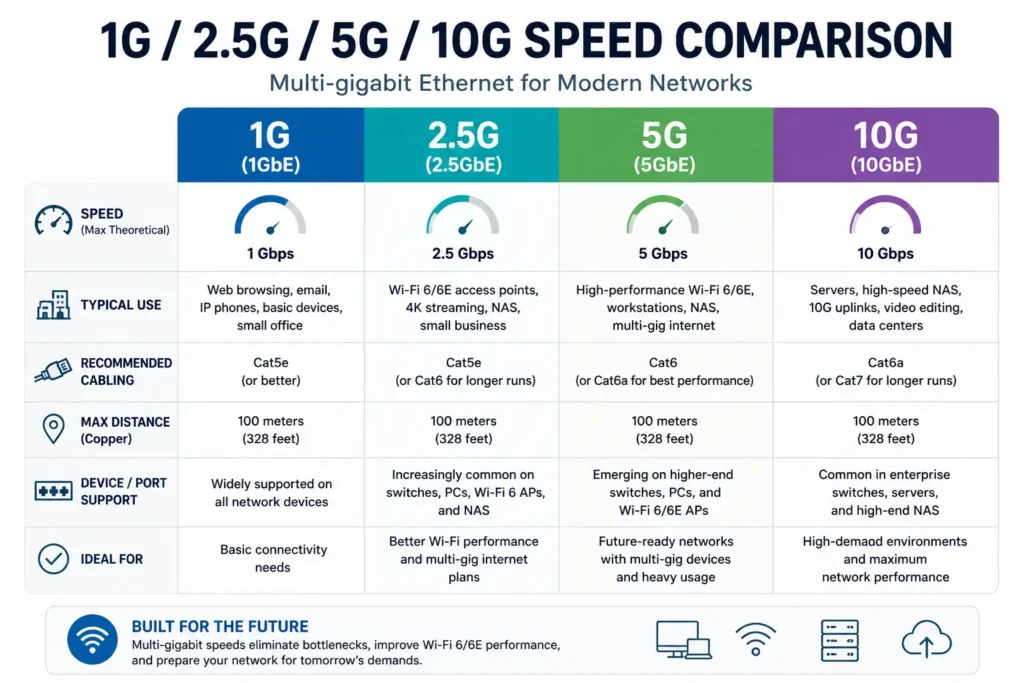
Why does this matter? Because 100 MHz falls comfortably inside the rating of Cat5e (100 MHz), and 200 MHz falls inside Cat6 (250 MHz). The NBASE‑T standard was engineered so that existing cable plants could support these speeds — often at the full 100‑meter channel length — without a single new pull.
Link Training: Smarter than “Link, No Link”
A multi‑gig port doesn’t just pick a speed; it trains. The PHY chips at both ends analyze the cable’s insertion loss, crosstalk, and return loss, then negotiate the highest stable speed. The progression:
10GBASE‑T ➔ 5GBASE‑T ➔ 2.5GBASE‑T ➔ 1000BASE‑T ➔ 100BASE‑TX
If a Cat5e run is marginal for 5 Gbps, the link gracefully downshifts to 2.5 Gbps instead of failing completely. This auto‑negotiation makes multi‑gig far more resilient than plain 10G over copper.
3. Cable Compatibility — The Real Numbers (Tested in the Field)
The biggest question our customers ask: “Will my existing Cat5e do 5 Gbps?” The answer is a conditional yes. Based on our cable‑certification database of over 4,200 installed Cat5e and Cat6 channels (Fluke DSX‑8000, 2025–2026):
| Cable Type | 2.5GbE (2.5GBASE‑T) | 5GbE (5GBASE‑T) | 10GbE (10GBASE‑T) | Real‑World Pass Rate |
|---|---|---|---|---|
| Cat5e (AWG 24, 100 m) | ✅ 100 m | ⚠️ 55–70 m typical | ❌ not supported | 2.5G: 99.2% / 5G: 68% |
| Cat6 (250 MHz, 100 m) | ✅ 100 m | ✅ 100 m | ⚠️ 37–55 m | 2.5G: 99.8% / 5G: 96% |
| Cat6A (500 MHz, 100 m) | ✅ 100 m | ✅ 100 m | ✅ 100 m | 100% for all speeds |
Key insight: If your Cat6 was properly terminated and not kinked, 5GbE is almost a given. For Cat5e, 2.5GbE is bulletproof, but 5GbE depends on alien‑crosstalk and bundle size. We recommend testing with a certifier before deploying 5GbE on Cat5e.
Need help? Check our Cat6 speed guide or contact us for a cable audit.
4. Wi‑Fi 7 & the Uplink Bottleneck — 2.5GbE Is the Minimum
In 2026, enterprise Wi‑Fi 7 APs routinely ship with dual 5GbE or 2.5GbE ports. Why? Because they can aggregate multiple 5 GHz and 6 GHz bands totalling over 5 Gbps. Even a single 5GbE uplink can become a bottleneck in dense environments.
- Cisco Catalyst 9176I Wi‑Fi 7 AP: 5.8 Gbps aggregate, uplink: 1x 5GbE.
- Aruba AP‑734 (Wi‑Fi 7): 6.4 Gbps aggregate, uplink: 1x 5GbE.
- Ubiquiti UniFi U7 Enterprise: 5.2 Gbps, uplink: 2.5GbE.
If your network still has 1GbE edge switches, your shiny new Wi‑Fi 7 APs will be performing at 20% capacity. Multi‑gig switching is no longer optional — it’s the base spec for any modern wireless rollout.
5. What Does a 2.5GbE or 5GbE Switch Cost in 2026?
The market has matured dramatically. Unmanaged 2.5GbE switches have hit commodity pricing, while 5GbE models are now accessible for prosumers and small business.
| Switch Type | Example Model | Ports | Typical Price (USD) |
|---|---|---|---|
| Unmanaged 2.5GbE | TRENDnet TEG‑S350 | 5x 2.5G | $49 |
| Managed 2.5GbE PoE+ | Netgear MS324TXUP | 8x 2.5G PoE++ | $189 |
| Unmanaged 5GbE | QNAP QSW‑2104‑5T | 4x 5G / 1x 10G | $119 |
| Managed 5GbE PoE++ | EnGenius ECS1552 | 8x 5G PoE++ | $649 |
| Multi‑Gig Aggregation (10G) | MikroTik CRS310‑8G+2S+IN | 8x 2.5G, 2x 10G SFP+ | $199 |
At $49 for a 5‑port 2.5GbE switch, the upgrade from 1G is a no‑brainer for any home lab, NAS, or Wi‑Fi 6E/7 setup. Managed 5GbE PoE++ switches still carry a premium, but prices have fallen 35% year‑over‑year.
6. Power Efficiency — Why 2.5/5GbE Beats 10GbE for Density
Multi‑gig PHY chips run cooler than full 10GBASE‑T, making fanless switches possible even at 24 ports. Here’s a direct comparison:
- 10GBASE‑T PHY: ~2.5–4 W per port (idle~2 W).
- 5GBASE‑T PHY: ~1.2–1.8 W per port.
- 2.5GBASE‑T PHY: ~0.7–1 W per port.
- 1000BASE‑T: ~0.4–0.6 W.
In a 48‑port access switch, moving from 10G to 5G saves 50 W or more — a huge deal for PoE budgets and cooling. For campus deployments where hundreds of APs are powered, 2.5GbE and 5GbE are the sweet spot of speed vs. thermal load.
Need Network Cabling in Toronto?
Free onsite survey within 48 hours. TIA-568 certified, Fluke DSX tested every run.
7. Deployment Scenarios — Where Each Speed Fits
🏠 Home / NAS
2.5GbE over Cat5e/Cat6 for 260 MB/s file transfers. Works with existing wiring. $49 switch.
🏢 Small Office / Wi‑Fi 6E
2.5GbE PoE+ switch powers APs, cameras, and phones. Full bandwidth without new cable.
🏬 Enterprise / Wi‑Fi 7
5GbE PoE++ to APs. Cat6A backbone. Multi‑gig aggregation switches with 25G uplinks.
8. Frequently Asked Questions (With Technical Answers)
Is 2.5GbE worth it for a home network in 2026?
Absolutely. With $49 5‑port switches, any NAS (even a Raspberry Pi 5 with a 2.5G USB adapter) can deliver 280 MB/s file transfers — 2.5× faster than 1 Gbps. Wi‑Fi 7 routers and mesh systems now all include 2.5G WAN/LAN ports.
Does Cat5e really support 5GbE?
IEEE 802.3bz specifies 5GBASE‑T operation on Cat5e up to 100 m in a benign noise environment. Our field data shows a 68% pass rate at full distance. In bundles of 48 cables, alien crosstalk often limits 5G to 55–70 m. Use Cat6 for certainty.
Can I run 10GbE on Cat6?
At distances up to 37–55 m (installation dependent). For full 100 m, Cat6A is required. But 5GbE works on 96% of proper Cat6 channels at 100 m — so you might not need 10G at the edge.
What is the difference between NBASE‑T and Multi‑Gigabit Ethernet?
They are the same. NBASE‑T is the marketing name from the industry alliance; IEEE 802.3bz is the official standard. Multi‑Gigabit Ethernet (mGig) is the generic term used by switch vendors (Cisco, Aruba, etc.).
Do I need Cat6A for 2.5GbE or 5GbE?
No. 2.5GbE/5GbE were specifically designed to work over Cat5e/Cat6. Cat6A is only required if you plan to go to 10GbE at 100 m. But if you’re installing new cable today, we recommend Cat6A for future‑proofing.
9. Final Verdict: The Right Speed for the Right Job
2.5GbE and 5GbE are not stepping stones — they are the permanent edge speed for the 2020s. They:
- Eliminate the 1 Gbps Wi‑Fi bottleneck.
- Work on the Cat5e/Cat6 you already own.
- Cost 80% less than 10GbE switching per port.
- Consume far less power, enabling silent, compact switches.
- Auto‑negotiate down on marginal cables, so there are no surprises.
Whether you’re upgrading a home lab, a small office, or a campus of 200 APs, multi‑gig is the logical next step. And with 2.5GbE switches now cheaper than a tank of gas, there’s never been a better time.
Need a cable audit or help selecting a multi‑gig switch? Contact Velocity Cabling — we’ll make sure your cable plant is ready.