Skip to content
Fluke DSX tested to TIA-568 limits · report included info@velocitycabling.com (647) 812-2640
Toronto & GTA · Commercial only

Business Paging & Intercom System Installers in Toronto

IP paging, analog PA, overhead speakers and two-way intercom for offices, warehouses, schools and commercial buildings. Designed around your ceiling height and noise level, not a fixed speaker count.

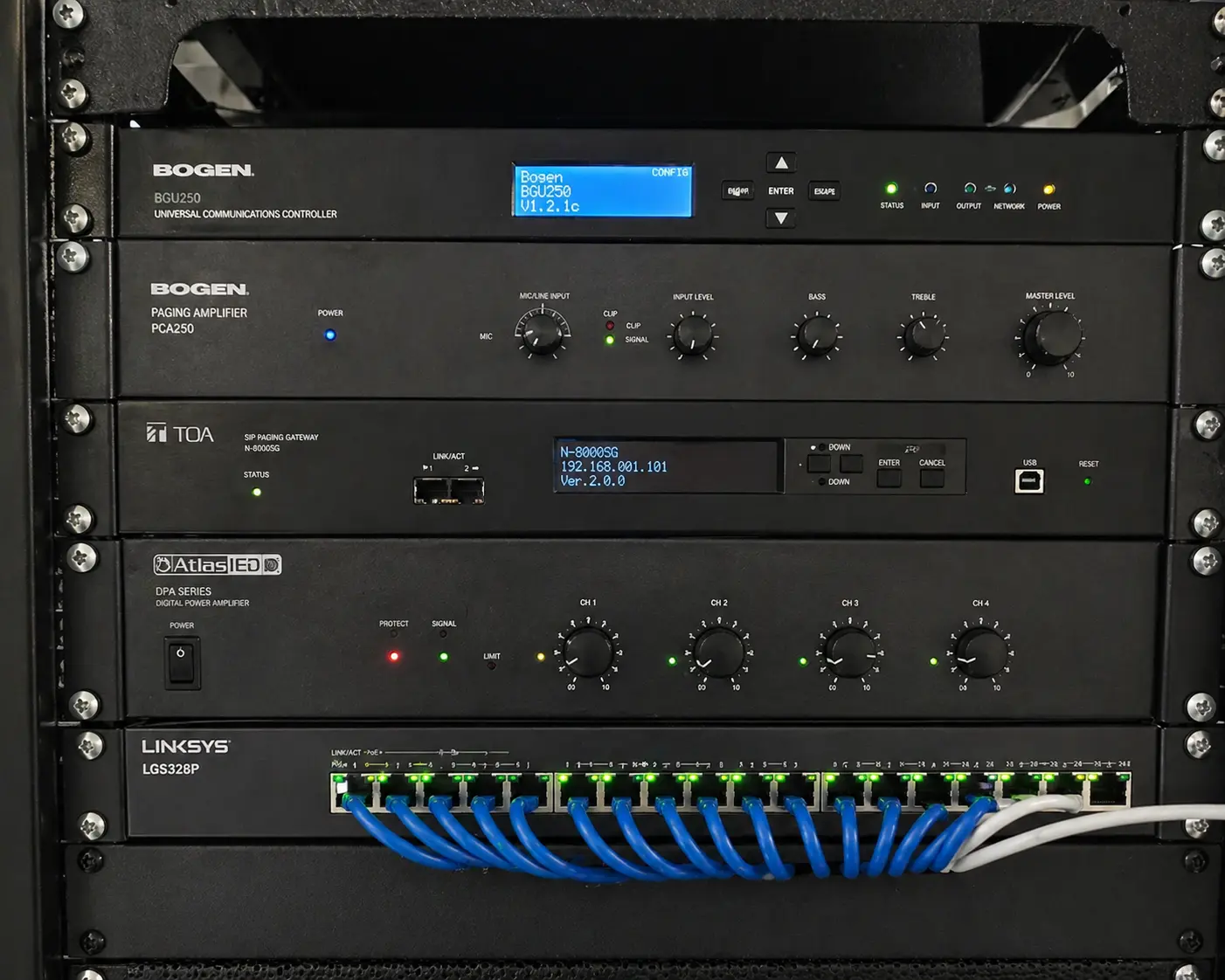
Bogen paging amplifier, TOA SIP gateway and AtlasIED power amplifier mounted in a commercial rack
Paging head-end: amplifier, SIP gateway and zone controller in a commercial rack.
IP and analog systems
Ambient noise measured on site
VoIP and Microsoft Teams integration
Every speaker tested and commissioned
Toronto & GTA
Start here

Paging or intercom? They solve different problems

A paging system broadcasts one-way audio to speakers across an area or zone, which is what you use for announcements, shift changes and emergency messages. An intercom provides two-way conversation between specific points, such as reception and a front door, or dispatch and a loading dock. Most commercial sites end up installing both.

The distinction matters because it changes the equipment entirely. Paging needs amplifier capacity, speaker coverage and zone control. Intercom needs a station at each end, a way to answer it, and usually a door release. Quoting one when you needed the other is the most common mistake we correct on existing systems.

The other thing worth settling early is how staff will actually use it. If announcements come from one reception desk, a single paging microphone is fine. If supervisors need to page from anywhere on the floor, the system needs to work from the phones people already carry, which points toward IP paging rather than a fixed console.

A practical test. If the requirement is "we need to tell everyone something", that is paging. If it is "somebody at the door needs to reach somebody inside", that is intercom. If both are true, they should be specified together so the cabling gets pulled once.

PagingIntercom
DirectionOne-way broadcastTwo-way conversation
ReachesA zone or the whole siteA specific station
Typical useAnnouncements, shift changes, emergenciesDoor entry, dock, secure areas
Initiated fromDesk phone, softphone or microphoneA call button at the station
Answered byNobody, it is a broadcastWhoever the station rings
Common add-onScheduled bells and tonesDoor release and video
System types

IP paging or analog PA?

IP paging runs audio over your existing Cat6 or Cat6A network to PoE-powered speakers and integrates directly with VoIP phone systems. Analog PA drives speakers from a central amplifier over dedicated 70V wire and works independently of the network. IP suits offices and multi-floor buildings. Analog suits warehouses and plants.

IP paging over your network

Audio travels over existing Cat6 or Cat6A using SIP. Each speaker is a PoE network device with its own address, so zones are defined in software rather than by how the wire was run. Adding a zone later is a configuration change, not a rewire.

Algo · Valcom · CyberData · AtlasIED

Analog 70V public address

A central amplifier drives speakers over dedicated two-conductor wire. Each speaker has a transformer tap setting how much power it draws. Simple, robust, and independent of the network, which matters where Wi-Fi and switching are unreliable.

Bogen · TOA · Bosch · Atlas Sound

Hybrid systems

Common on sites with an office wing and a warehouse. IP speakers and phone integration through the offices, analog horns on the production floor, bridged so one page reaches both. You get network flexibility where it helps and amplifier simplicity where it matters.

Bridged IP + 70V
ConsiderationIP pagingAnalog 70V
CablingCat6 or Cat6A network dropDedicated speaker wire
PowerPoE from the switchCentral amplifier
ZonesDefined in softwareSet by amplifier and wiring
Phone systemNative SIP integrationPaging interface required
If the network is downPaging is downStill works
Adding a speakerAny spare network portDepends on amplifier headroom
Best suited toOffices, schools, multi-floorWarehouses, plants, exterior
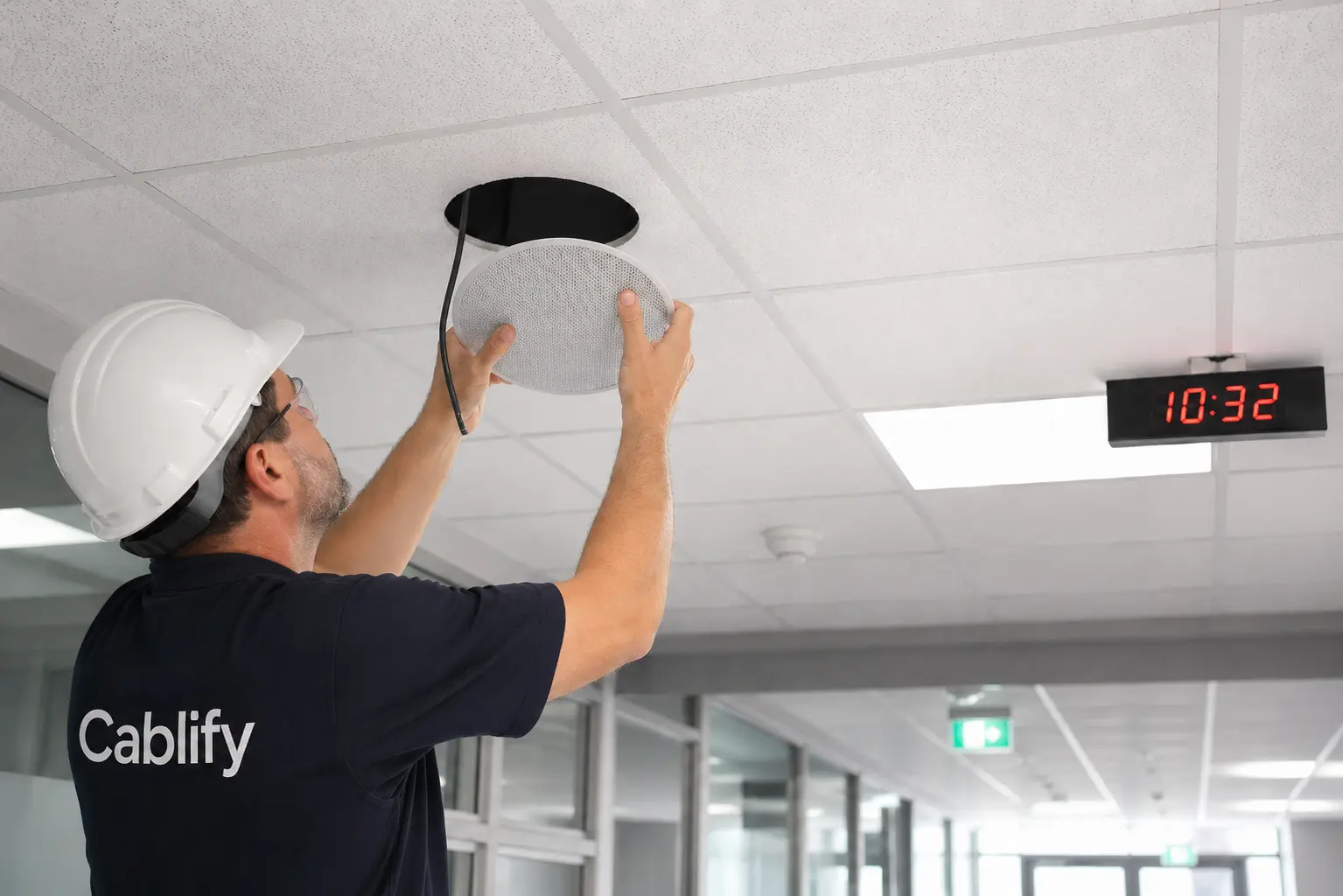
Technician fitting a ceiling speaker into a suspended office ceiling tile
Ceiling speaker installation in a suspended office ceiling.
Hardware

Speaker types and where each belongs

Ceiling speakers suit offices, retail and clinics at normal ceiling heights. Horn speakers are required in warehouses, plants and outdoors where ambient noise runs 80 to 90 dB. Surface-mount covers stairwells and concrete ceilings. Pendant speakers hang from high ceilings where neither ceiling nor wall mounting works.

Choosing the wrong type is the single most common reason a paging system fails to do its job. A ceiling speaker installed in a warehouse will be physically present and completely inaudible. A horn speaker in an open-plan office will be painful.

  • Ceiling. Flush in T-bar or drywall. Even coverage, clean appearance, offices and retail.
  • Horn. High output, directional. Warehouses, plants, docks and exterior areas.
  • Surface-mount. Wall or column. Stairwells, corridors and concrete ceilings where recessing is impossible.
  • Pendant. Suspended from high ceilings. Atriums, gyms and open high-bay spaces.
  • Weatherproof horn. Sealed and UV-rated for yards, loading areas and parking.
Design

How speaker count is actually calculated

Speaker count comes from ceiling height and ambient noise, not floor area alone. Output drops roughly 6 dB every time the distance doubles, and announcements need to land about 10 dB above the background noise to be understood. That is why the same square footage needs a different system in an office than in a warehouse.

Anyone quoting "one speaker per 400 square feet" is guessing. That figure is only true at one ceiling height and one noise level. We measure the ambient level on site, including whether it changes between a day shift and a night shift, and design against what the building actually does.

EnvironmentAmbient noiseTarget outputSpeaker type
Private office, clinic40–50 dB60–65 dBCeiling, 8–10 ft
Open plan office50–60 dB70–75 dBCeiling, 9–12 ft
Retail floor55–65 dB75–80 dBCeiling or pendant
Light assembly65–75 dB85–90 dBPendant or horn
Warehouse aisles75–85 dB90–95 dBHorn, high mount
Plant floor, machining85–95 dB100–105 dBHigh-SPL horn
Exterior yard, dock60–80 dB90–95 dBWeatherproof horn

Planning ranges for scoping a system, not a substitute for a reading taken on site.

Loud is not the same as clear

Hard surfaces in a warehouse reflect sound, and reflections smear speech. Pushing more volume through fewer horns usually makes intelligibility worse, not better. More speakers at moderate output, positioned along the aisles rather than across them, is what produces announcements people can actually follow.

Where speech clarity is a life-safety requirement, systems are assessed against intelligibility measures such as STI rather than sound pressure alone.

Tap settings, zone by zone

On a 70V system every speaker has a transformer tap setting how much amplifier power it draws, usually between 1W and 30W. Tapping a whole building uniformly is what produces the classic complaint: the office is deafening and the dock cannot hear a thing.

Taps get set by area. Offices low, warehouse high, exterior highest. The amplifier is sized above the total connected load so an all-call emergency page has reserve power rather than clipping.

Intercom

Door, dock and entry intercom

A business intercom gives two-way communication between a station and whoever answers it. A visitor presses the button at the door, reception's desk phone rings, they speak, verify, and release the lock without leaving the desk. On IP systems the same call can ring a mobile or softphone anywhere.

  • Entry intercom. Lobby and suite doors in office and multi-tenant buildings, with electric strike or maglock release.
  • Dock door intercom. Drivers reach dispatch or receiving without entering the building. Calls ring a dedicated extension any authorised staff member can answer.
  • Video intercom. Adds a live camera view so reception can see who is at the door before releasing it.
  • Secure area intercom. Server rooms, records storage and restricted areas where entry needs authorisation rather than just a card.
  • Gate and yard intercom. Weatherproof stations at vehicle gates, connected to security or dispatch.
  • Multi-tenant panels. One panel, individual tenant buttons, each ringing the right suite. Directory updated through a web interface on IP systems.
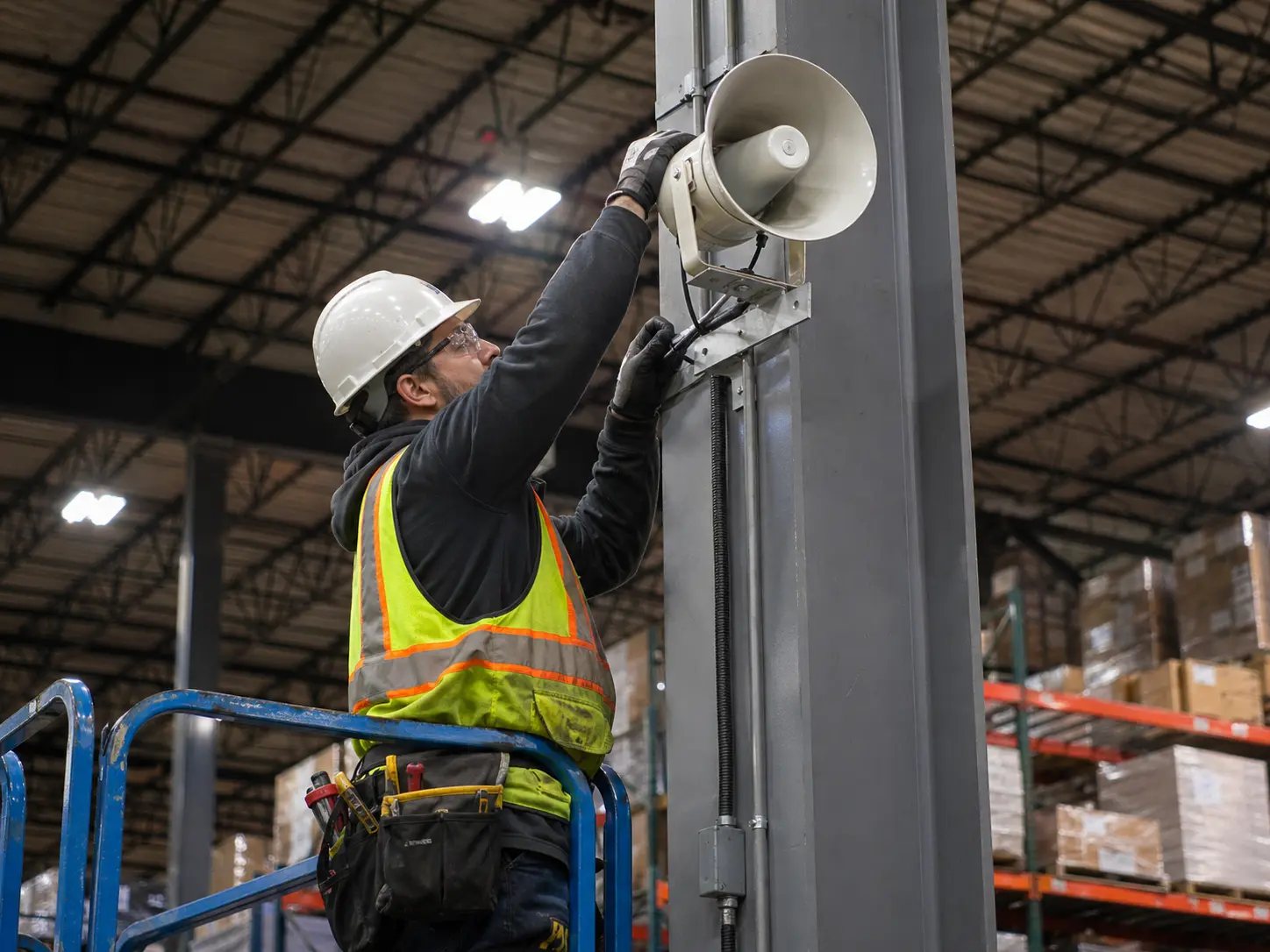
Technician mounting a horn speaker to a warehouse structural column from a lift
High-mount horn speaker installation in a warehouse.

Brands we install. Algo, 2N, Aiphone and Comelit for intercom. Algo, Valcom, CyberData and AtlasIED for IP paging. Bogen, TOA, Bosch and Atlas Sound for analog. We are not a single-brand dealer, so the recommendation follows the building rather than a supply agreement.

Integration

Paging from the phones your staff already use

SIP-capable IP paging integrates directly with Microsoft Teams Phone, Cisco and most hosted PBX platforms. Staff dial a paging extension from their existing desk phone, Teams client or mobile to reach a zone or the whole building. No separate console, no new hardware on desks, nothing to train.

This is usually the feature that decides IP over analog. A warehouse supervisor with a mobile can page the dock from wherever they are standing. A receptionist announces a visitor by pressing a speed dial. A manager working from home can still reach the floor.

Automated announcements are the other half of it. Scheduling software can trigger shift changes and break times, access control can announce a delivery at the gate, and a warehouse management system can push alerts to a zone without anyone picking up a handset.

  • Teams Phone. A paging extension configured in your tenant, dialled from desktop, mobile or desk phone.
  • Hosted PBX and Cisco. Standard SIP registration, no proprietary gateway required.
  • Zone dialling. Different extensions for different zones, plus an all-call for emergencies.
  • Scheduled tones. Shift changes, breaks and school bells run on a schedule rather than a person remembering.
  • Emergency override. All-call that ignores zone settings, triggered from a phone, a button or an integration.

Already have an analog system? An older 70V system can usually be connected to a modern VoIP platform through a paging interface, which is considerably cheaper than replacing working amplifiers and speakers. We assess what is installed before recommending anything gets torn out.

Network dependency, stated plainly. IP paging relies on your switching and PoE. If the network is down, paging is down. Where paging carries safety-critical announcements, that is an argument for analog on the production floor, or for UPS-backed switches feeding the speakers.

Facilities

Where we install paging and intercom

Warehouses & distribution

High-SPL horns along aisles, zone paging by department, dock intercom, weatherproof horns for the yard.

Manufacturing

Horns positioned clear of machinery noise, zone separation between production and offices, emergency all-call.

Offices

Ceiling speakers with zone paging by floor or department, Teams and VoIP integration, visitor announcement from reception.

Multi-tenant buildings

Lobby and suite entry intercom, tenant directory panels, common-area paging, door release from each suite.

Schools

Classroom speakers, all-call and zone paging, bell scheduling, emergency lockdown announcement.

Healthcare & clinics

Low-output ceiling speakers in clinical areas, zone separation from waiting rooms, discreet staff paging.

Retail & hospitality

Background music combined with paging, zone control by area, staff intercom between front and back of house.

Logistics & yards

Gate intercom, exterior horns, dispatch communication across yard and trailer staging.

Server rooms & secure areas

Intercom at controlled-access doors where entry needs authorisation rather than a card alone.

Get a quote

Free site survey, speaker layout included

Tell us about the space. We measure ambient noise and ceiling height on site, then send an itemised proposal with the speaker layout and zone plan, not just a price.

What helps us scope it

  • Approximate square footage and ceiling height
  • How many zones you want to page independently
  • Whether an existing paging system is in place
  • Your phone system, if you want paging integrated
  • Any intercom points such as doors, docks or gates
  • A floor plan if you have one

Have a floor plan to send? Submit the form and reply to the confirmation email with it attached, or email info@velocitycabling.com.

Used only to answer this enquiry. See our privacy policy. Prefer to talk? Call (647) 812‑2640.

Questions

Paging and intercom FAQs

A paging system broadcasts one-way audio to speakers across an area or zone, which is what you use for announcements, shift changes and emergency messages. An intercom provides two-way conversation between specific points, such as a reception desk and a front door, or dispatch and a loading dock. Many commercial sites install both, with the intercom handling entry and the paging system handling announcements.

IP paging systems that run over your existing Cat6 or Cat6A network using SIP, and analog 70V public address systems driven from a central amplifier. We install ceiling speakers for offices and retail, horn speakers for warehouses and exterior areas, surface and pendant speakers where ceiling mounting is not possible, plus zone controllers, amplifiers and paging microphones.

Yes. SIP-capable IP paging integrates directly with Microsoft Teams Phone, Cisco, and most hosted PBX platforms. Staff dial a paging extension from their existing desk phone or softphone to page a zone or the whole building, so there is no separate console to learn. Analog systems can also be connected to a phone system through a paging interface.

It depends on ceiling height and ambient noise rather than floor area alone. Output drops roughly 6 dB each time the distance doubles, and announcements need to land around 10 dB above the background noise to be understood. A quiet office at 40 to 50 dB needs far fewer speakers than a warehouse running at 80 to 90 dB. We measure the ambient level during the survey rather than working from a rule of thumb.

Usually one of two reasons. Either the speakers are ceiling type rather than high-SPL horns, so they cannot overcome forklift, conveyor and HVAC noise, or a small number of horns have been turned up to compensate. Hard surfaces reflect that volume and smear the speech. More speakers at moderate output, positioned along the aisles, produces clearer results than fewer speakers turned up.

Yes. Dock door intercom lets drivers reach dispatch or receiving without entering the building, and entry intercom lets reception speak with a visitor and release the door without leaving the desk. IP intercoms answer on any desk phone or mobile, and video intercom adds a camera view to the same workflow.

Yes. Common work includes adding zones or speakers to an existing system, replacing failed amplifiers, correcting tap settings where one area is deafening and another inaudible, and connecting an older analog system to a new VoIP phone platform through a paging interface. We assess what is already installed before recommending replacement.

Yes. School systems typically include classroom speakers, zone and all-call paging, emergency announcement capability and bell scheduling. Healthcare sites need zone separation between patient areas, waiting rooms and staff-only areas, with low-output ceiling speakers appropriate to clinical spaces.

It depends on the number of speakers and zones, ceiling height and access, whether the system is IP or analog, the amplifier capacity needed, and whether existing cabling can be reused. We do not quote paging over the phone. After a free site survey you receive an itemised written proposal with the speaker layout included.

Toronto including Etobicoke, North York and Scarborough, plus Mississauga, Brampton, Vaughan, Markham, Richmond Hill, Oakville, Burlington and Hamilton, and the wider GTA depending on project size.

Reviewed October 2026 · Velocity Cabling, Toronto and the GTA.

Call Free Site Survey