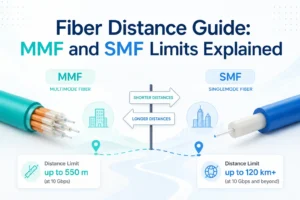

Multimode fiber Cabling is still the right call for most intra-building and campus backbone work. The distances are short, the transceivers are cheaper than single-mode equivalents, and the installed base is enormous. The practical question most network managers face is not whether to use multimode, but which grade: OM3 or OM4. They look nearly identical, they terminate the same way, and they use the same transceivers. The differences sit in the glass itself, and those differences matter once you start pushing 40G, 100G, or longer runs.
This guide breaks down every relevant comparison between OM3 and OM4, tells you where each one belongs, and helps you make a defensible decision for your next project.
OM3 vs OM4 Bandwidth
Both OM3 and OM4 are 50/125 µm laser-optimized multimode fiber. The core is 50 µm, the cladding is 125 µm, and both grades are designed for use with 850 nm VCSELs. The key performance metric for laser-optimized multimode is effective modal bandwidth (EMB), measured in MHz·km.
OM3 has a minimum EMB of 2,000 MHz·km at 850 nm. OM4 raises that floor to 4,700 MHz·km at 850 nm. That is more than double the bandwidth capacity in the same fiber diameter. At 953 nm, which matters for SWDM and certain CWDM4 applications, OM4 also outperforms OM3 by a meaningful margin. In practice, higher EMB translates directly into longer achievable distances at any given data rate, because the fiber can carry the signal with less modal dispersion before the receiver can no longer decode it cleanly.
OM3 vs OM4 Speed
Both OM3 and OM4 support the same top-line Ethernet speeds in the IEEE standards. The fiber grade does not change the maximum speed. It changes how far you can run that speed. The table below shows supported speeds under current IEEE 802.3 standards.
| Speed | Standard | OM3 Max Distance | OM4 Max Distance |
|---|---|---|---|
| 1 GbE | 1000BASE-SX | 300 m | 400 m |
| 10 GbE | 10GBASE-SR | 300 m | 400 m |
| 40 GbE | 40GBASE-SR4 | 100 m | 150 m |
| 100 GbE | 100GBASE-SR4 | 70 m | 100 m |
| 100 GbE | 100GBASE-SR10 | 100 m | 150 m |
| 400 GbE | 400GBASE-SR8 | 50 m | 100 m |
The pattern is consistent. At every speed, OM4 buys you more reach. At 10G, the extra 100 m rarely matters inside a building. At 100G and 400G, that gap can determine whether your design works or requires expensive active optical cables or single-mode transceivers.
OM3 vs OM4 Distance
Distance is where the OM3 versus OM4 decision gets concrete. For 1G and 10G Ethernet in a typical office or warehouse environment, both grades cover any reasonable run easily. Core-to-distribution hops in a mid-size building rarely exceed 150 m, and both grades handle that with headroom.
The math changes for high-density data centre interconnects and campus backbones. If your MDA-to-HDA run is 90 m and you are running 100GBASE-SR4, OM3 puts you 20 m beyond its rated limit. That is not a margin problem, that is a standards violation. OM4 keeps you inside the 100 m envelope. For 400G, the 50 m OM3 limit is tight enough that most data centre designs with OM3 backbone require MPO trunk cassette systems carefully staged to stay under that number. OM4 doubles that headroom.
OM3 vs OM4 Color
The TIA-598 standard specifies aqua (turquoise) as the jacket color for both OM3 and OM4. You read that correctly. Both grades share the same standardized jacket color. Some manufacturers differentiate OM4 with a violet or eggplant-colored jacket, and that has become a common de facto convention in North American data centres. However, it is not a TIA requirement, and not every vendor follows it.
Do not rely on jacket color alone to identify the grade of installed fiber. Pull the documentation. Check the reel labels, the patch panel labels, or the as-built drawings. If you are auditing an existing plant without documentation, test with an OTDR and compare the results against known EMB specs, or treat it as OM3 until proven otherwise.
Can I Mix and Match OM3 and OM4?
Technically you can terminate an OM3 patch cord into an OM4 trunk and the light will pass. The connector geometry is the same. The problem is that a mixed channel performs to the lowest-grade component in that channel. A 100GBASE-SR4 link running over a channel with one OM3 segment and three OM4 segments is, for distance purposes, an OM3 channel. You lose the OM4 advantage entirely.
Need Network Cabling in Toronto?
Free onsite survey within 48 hours. TIA-568 certified, Fluke DSX tested every run.
ANSI/TIA-568.2-D does not prohibit mixing OM3 and OM4 in a channel, but it requires that channel performance be calculated using the parameters of the lowest-grade fiber present. Document any mixed segments clearly in your as-builts. Installers who mix grades without noting it create troubleshooting nightmares when the network is upgraded later.
In practice, mixing grades is only acceptable as a deliberate, documented decision, such as splicing new OM4 trunk into an existing OM3 plant for an intermediate building where the run stays within OM3 limits. It is never acceptable as a result of using whatever patch cord happened to be in the bag.
Which Fiber Cable to Choose: OM3 or OM4?
Start with your distance requirements and your target speed, then work backward. If every run in your building is under 70 m and your highest planned speed is 100G, both grades work, and the cost difference is not a strong deciding factor. If any run approaches or exceeds 70 m at 100G, install OM4 and close the conversation.
Cost difference between OM3 and OM4 has narrowed significantly. On a typical 24-strand backbone pull, the material delta is modest. Labor is the same. Connectors are the same. The incremental cost to step up to OM4 is small relative to the cost of re-pulling fiber two years later when the network needs an upgrade. Unless you have a hard budget constraint and your distances definitively fit within OM3 limits, OM4 is the more rational default for new installations.
Single-mode OS2 is a separate conversation. For any inter-building campus run over 300 m, or any link where future 400G or 800G is a realistic possibility beyond the reach of OM4, OS2 with duplex LC or MPO is the right choice. Single-mode transceivers cost more today, but transceiver costs continue to fall and the fiber plant lasts 20 or more years.
Use Cases for OM3 and OM4 Fiber
Where OM3 Still Makes Sense
OM3 is a reasonable choice for horizontal or riser backbone in a single-floor or two-floor office where all fiber runs are under 100 m and the highest required speed is 10G. It also makes sense when you are extending an existing well-documented OM3 plant and the new runs fit comfortably within OM3 distance limits. There is no engineering reason to rip out functioning OM3 that meets your current and near-term speed requirements.
Where OM4 Is the Right Call
OM4 is the correct choice for new data centre backbone work, MDA-to-HDA trunks, top-of-rack to end-of-row switch connections, and any environment where 40G, 100G, or 400G links are in the plan. It is also the right choice for any building where runs routinely reach 100 m or more, such as a warehouse spine running from a server room to distribution switches at the far end of a long floor. The extra bandwidth headroom keeps the installation valid for the next speed upgrade cycle without a fiber replacement.
For pre-terminated MPO trunk systems, which are now standard in high-density data centres, OM4 is the default specification from most reputable manufacturers and for good reason. The labor cost to install a pre-terminated MPO system is largely fixed regardless of fiber grade, so there is no economic argument for saving a few dollars per meter on OM3 in that context.
Frequently Asked Questions
Planning a cabling project in the GTA?
Velocity Cabling designs and installs structured cabling, fiber, and security systems for businesses across Toronto, Mississauga, Brampton, and the surrounding area.