Most business owners start with a number. “We need eight cameras.” Then the system goes in and the first time something happens, the footage shows a blurry figure walking out the door and nothing more.
The right camera count depends on two things: which spots matter, and what each camera needs to show in those spots. A camera over the front door has a different job than a camera looking across a parking lot. Once you know the job, the count follows.
This guide breaks it down by property type, with the placement rules we use when designing commercial CCTV systems across Toronto and the GTA.
Identify vs Detect: The Difference That Sets Your Camera Count
Every camera does one of four jobs. The industry standard for this is IEC 62676-4, and it uses a measurement called pixel density, which is the number of image pixels covering one metre of the scene.
| Level | Pixels per metre | What you can tell | Typical use |
|---|---|---|---|
| Detect | 25 px/m | Something or someone is there | Fence lines, yards, open lots |
| Observe | 62 px/m | What a person is doing, clothing colour | Aisles, hallways, sales floors |
| Recognize | 125 px/m | Someone you already know | Staff areas, interior doors |
| Identify | 250 px/m | A stranger’s face, clearly enough for police | Entrances, cash counters, exits |
The math is simple. Divide the camera’s horizontal resolution by the width of the scene in metres.
- A 4MP camera (2560 pixels wide) covering a 10 metre wide scene gives 256 px/m. That is enough to identify.
- The same camera covering a 40 metre wide scene gives 64 px/m. That is only good enough to observe.
- A 4K camera (3840 pixels wide) can identify across about 15 metres.
This is why one wide camera cannot cover a whole store and still catch faces. The wider the view, the less detail per person. Most well designed systems pair a few identify cameras at choke points with wider overview cameras everywhere else.
If a scene is a fixed width, a varifocal lens lets the installer zoom in to hit the pixel density you need instead of guessing at a fixed focal length.
Placement Rules That Apply to Every Property
Entrances and exits
Every door people use gets one identify camera. This is the single most important camera in any system, because every person who enters has to pass it.
- Mount it inside, facing the door, at about 2.1 to 2.7 metres (7 to 9 feet). Higher than that and you get the top of a head or a ball cap brim.
- Keep the downward angle shallow, ideally under 15 to 20 degrees.
- Glass doors cause strong backlight. Pick a camera with true WDR (120 dB or better) or the face turns into a dark silhouette on sunny days.
- Add a second, wider camera outside the door to show arrival direction and vehicles.
Cash areas and high-value spots
Cash counters, safes, pharmacy counters and inventory cages need two views. One overhead camera shows hands, cash and the till. A second camera faces the customer side at identify level. The overhead view proves what happened. The front view proves who did it.
Blind spots
Blind spots are rarely where people expect. The common ones we find on site surveys:
- Directly under a camera. Most cameras cannot see the 2 to 3 metres below their mount.
- Behind tall shelving, racking or displays added after the system went in.
- Corners of an L-shaped room.
- Stairwells and back corridors that connect to exits.
- Areas that go dark at night when lights are on timers.
The fix is usually overlap. Position cameras so each one can see the area under its neighbour. For low-light zones, check the camera’s rated minimum illumination and IR range. Our guide to lux levels and night view cameras covers how to read those specs.
Retail Stores
Retail is about two things: shoplifting and cash handling. Most losses happen at the door, the till and the back room.
| Location | Cameras | Level |
|---|---|---|
| Customer entrance | 1 inside, 1 outside | Identify / Observe |
| Each cash register | 1 overhead, 1 customer-facing | Recognize / Identify |
| Sales floor | 1 per 2 to 3 aisles, or 1 per 90 to 140 m² of open floor | Observe |
| High-theft displays | 1 each | Recognize |
| Stock room and back door | 1 to 2 | Identify at the door |
| Office or safe | 1 | Recognize |
Typical count: a 1,500 sq ft convenience store or boutique runs well on 6 to 8 cameras. A 5,000 to 10,000 sq ft store usually needs 12 to 20.
Staff theft often happens at the register and in the back, not on the floor. Make sure the till camera can read the cash drawer, and pair it with your POS if the NVR supports transaction overlays.
Offices
Offices have fewer customers but more expensive equipment, confidential files and after-hours access. The focus shifts to entry control and after-hours events.
| Location | Cameras | Level |
|---|---|---|
| Main entrance and reception | 1 to 2 | Identify |
| Secondary and fire exits | 1 each | Recognize |
| Elevator lobby or stairwell doors | 1 per floor | Recognize |
| Main corridors | 1 per long hallway | Observe |
| Server or network room | 1 | Recognize |
| Shipping and mail area | 1 | Observe |
Typical count: a 3,000 to 5,000 sq ft office usually needs 4 to 8 cameras. A full floor of 15,000 sq ft or more is closer to 10 to 16.
Skip cameras aimed at individual desks or screens. They add little security value and can cause privacy problems. In Ontario, employers with 25 or more employees must have a written electronic monitoring policy, and cameras are part of that. Our post on video surveillance guidelines in Ontario covers signage and where cameras should not go.
Need Network Cabling in Toronto?
Free onsite survey within 48 hours. TIA-568 certified, Fluke DSX tested every run.
Offices get the most value when cameras tie into the door system. When a badge is used at a door, the matching clip is linked to that event. See our access control systems page for how the two work together.
Warehouses
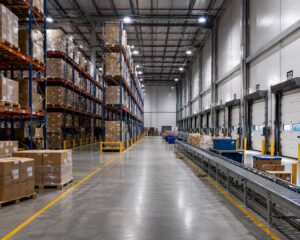
Warehouses are where camera counts climb fast. Long aisles, high ceilings, forklifts, trailers and multiple dock doors all need their own coverage.
| Location | Cameras | Level |
|---|---|---|
| Each loading dock door | 1 (inside, facing out) | Recognize |
| Dock row overview | 1 per 4 to 6 doors | Observe |
| Shipping and receiving desk | 1 | Identify |
| Staff entrance and time clock | 1 | Identify |
| Aisle ends and intersections | 1 per main intersection | Observe |
| High-value cage | 1 to 2 | Recognize |
| Trailer yard and fence line | 1 per 30 to 50 m of fence | Detect |
Typical count: a 20,000 sq ft warehouse with 4 dock doors needs about 16 to 24 cameras. A 100,000 sq ft distribution centre often runs 48 to 80 or more.
Loading docks
Dock cameras settle most disputes: short shipments, damaged pallets and missing product. A camera inside each door should show the trailer opening, the dock plate and the pallet as it crosses. Mount it high enough to clear forklifts, usually 3.5 to 4.5 metres, and aim it slightly downward into the trailer. Bright daylight outside and a dark interior make WDR essential here too.
Aisles and racking
Use corridor mode (a 9:16 vertical image) for long aisles. The camera image turns vertical, so you get more of the aisle’s length and waste fewer pixels on the racking. For large open floors, a PTZ camera can cover a wide area during live monitoring, but it only sees where it is pointed. Pair it with fixed cameras for recording.
Cable runs in a warehouse often go past the 100 metre Ethernet limit. That means extra network switches mid-building or a fibre backbone. We cover this in detail on our warehouse CCTV installation page.
Parking Lots
Parking lots are the hardest area to cover well. They are wide, dark at night and full of moving vehicles. Split the job into three parts.
| Location | Cameras | Level |
|---|---|---|
| Each vehicle entry and exit | 1 overview + 1 LPR if plates matter | Observe / Identify (plate) |
| General lot coverage | 1 per 40 to 60 stalls (4K or multi-sensor) | Detect / Observe |
| Walkway to building | 1 | Recognize |
| Dumpster and loading area | 1 | Observe |
Typical count: a 50-stall lot with one entrance runs on 3 to 5 cameras. A 200-stall lot with two entrances usually needs 8 to 12.
Licence plate cameras
A regular overview camera will not read plates at night. Headlights wash out the image and motion blurs the characters. Licence plate recognition (LPR) cameras use a narrow field of view, about 3 to 4 metres wide per lane, a fast shutter of 1/1000 second or faster, and IR tuned for reflective plates. Place them at the gate or entry lane where cars slow down, not across the open lot.
Multi-sensor cameras
A multi-sensor camera has two to four lenses in one housing. It covers a full 180 or 360 degree view from one mount, one cable and one pole. For parking lots this often costs less than three or four separate cameras once you add up poles, trenching and cable runs.
What Else Changes the Count
- Ceiling height. Higher mounts see more floor but lose face detail. High-bay warehouses need longer focal lengths.
- Lighting. Dark areas need IR range that matches the distance. Built-in IR on cheap cameras often reaches 20 to 30 metres at best.
- Insurance and lease terms. Some insurers and landlords require coverage of specific doors or a minimum retention period, often 30 days.
- Analytics. Line crossing and loitering alerts can reduce how many cameras need live monitoring. See how AI analytics fit into modern systems.
- Power. Every camera draws PoE from a switch. Heaters, IR and PTZ motors raise the draw quickly. Our guide to planning PoE power for cameras and phones shows how to size the switch.
Quick Reference: Starting Camera Counts
| Property | Size | Starting range |
|---|---|---|
| Small retail | Under 2,000 sq ft | 4 to 8 |
| Mid-size retail | 5,000 to 10,000 sq ft | 12 to 20 |
| Small office | 3,000 to 5,000 sq ft | 4 to 8 |
| Full office floor | 15,000+ sq ft | 10 to 16 |
| Warehouse | 20,000 sq ft | 16 to 24 |
| Distribution centre | 100,000+ sq ft | 48 to 80+ |
| Parking lot | 50 stalls | 3 to 5 |
| Parking lot | 200 stalls | 8 to 12 |
These are starting points, not quotes. Two buildings the same size can need very different counts depending on door layout, racking and what you are trying to prevent.
For a single shop, clinic or office under 16 cameras, our business CCTV installation service is the right fit. For multi-site systems, warehouses and larger buildings, see commercial CCTV installation.
Not sure how many cameras your building needs? Book a site survey or call (647) 812-2640. We walk the space, mark every camera location on a floor plan and tell you what each one will show before anything is installed.
Frequently Asked Questions
How many security cameras does a small business need?
Most small businesses under 2,000 sq ft need 4 to 8 cameras. That covers each entrance, the cash area, the back door and the main floor. Add more if you have a stock room, a parking area or blind spots behind displays.
What resolution do I need to identify a face?
You need about 250 pixels per metre across the scene. A 4MP camera can identify faces across a scene roughly 10 metres wide. A 4K camera can do it across about 15 metres. Resolution alone does not guarantee it; mounting height, angle and lighting matter just as much.
Can one 4K camera replace several lower-resolution cameras?
Sometimes, for overview coverage. It cannot replace identify cameras at doors and counters, because a wide 4K view still spreads its pixels over too much space to capture faces. Use 4K for large open areas and keep dedicated cameras at choke points.
Where should security cameras not be installed in Ontario?
Never in washrooms, change rooms or other areas where people expect privacy. Avoid pointing cameras at neighbouring properties or recording audio without a clear reason. Post signage at entrances so people know recording is in place.
How high should security cameras be mounted?
For face identification, mount cameras at about 2.1 to 2.7 metres (7 to 9 feet). Overview cameras can go higher, usually 3 to 4.5 metres, to see over people and shelving. In warehouses, dock cameras often go at 3.5 to 4.5 metres to clear forklifts.