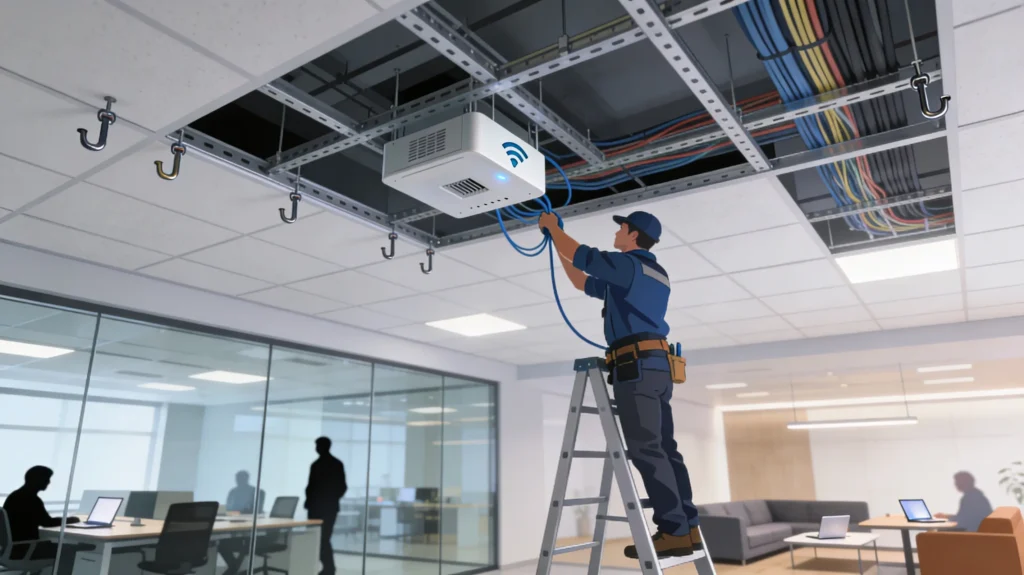

Most IP cameras and Wi-Fi access points live in ceilings and on walls where nobody will ever plug in a laptop. Even so, a lot of installs still put a surface-mount box and a jack beside every device, then add a short patch cord to reach it. That is three extra parts at the hardest place on the job to work.
Since TIA-568.2-D was published in 2018, there has been a recognized alternative: the modular plug terminated link, or MPTL. The horizontal cable ends in a field-terminated plug that goes straight into the device, and the link is certified like any other. This guide explains where an MPTL is the right call, where it is not, why a cheap crimped plug on solid cable is the most common way to get it wrong, and how to test it so the result holds up.
Key takeaways
- An MPTL runs from a jack in the patch panel to a field-terminated plug at the device. It can be up to 90 m long and is defined in Annex F of ANSI/TIA-568.2-D.
- It suits fixed devices where an outlet and cord are not practical: access points, cameras, displays, sensors and PoE lighting. It does not suit desks or anything that moves.
- It must pass permanent link limits, tested with a permanent link adapter at the panel and a patch cord adapter at the plug.
- Use a category-rated field-termination plug made for solid conductors. A crimp plug designed for stranded patch cable can cut or miss a solid conductor and cause intermittent faults.
- For PoE devices, choose the MPTL (+PoE) test limit, which adds resistance unbalance checks.
What Is a Modular Plug Terminated Link?
A modular plug terminated link (MPTL) is a horizontal cable terminated on a jack at the patch panel and on an RJ45 plug at the far end, where it plugs directly into the device. There is no outlet and no device patch cord. It can be up to 90 m long and must meet the same transmission limits as a permanent link.
Before 2018, TIA-568 required every horizontal cable to end at a telecommunications outlet so users had flexible access. TIA-568.2-D kept that as the normal approach but added Annex F, which recognizes the MPTL for cases where an outlet and patch cord are not practical. Belden, which brought the proposal to TIA, describes it as a way to connect access points, cameras and displays without the outlet and cord. Internationally, ISO/IEC 14763-4 covers how MPTLs are measured.
A few rules come with it:
- Jack at one end, plug at the other. Plug-to-plug links are not supported.
- Up to 90 m of horizontal cable, the same as a permanent link. The switch-side patch cord still counts toward the 100 m channel.
- An optional consolidation point is allowed along the run.
- Permanent link limits apply. An MPTL is certified against the permanent link limits for its category.
Where an MPTL Makes Sense, and Where It Does Not
The standard treats the MPTL as a solution for limited cases, not a replacement for the outlet. The simple test: if a person will ever plug something in at that location, use an outlet. If a fixed device lives there for years and nobody touches the connection, an MPTL is usually the cleaner build.
| Device or location | MPTL? | Why |
|---|---|---|
| Ceiling-mounted Wi-Fi access points | Yes | Fixed position, no user access, and a cleaner ceiling. Fluke notes the standards recommend two Cat6A links to each AP in new installs, and both can be MPTLs. |
| IP and PTZ cameras | Yes | Fewer parts at height. In a warehouse, every return visit to a camera on the racking or roof steel means a lift, so fewer connection points pays off. |
| Digital signage and wall displays | Usually | Good when the display is fixed and the cable can be hidden behind it. Use an outlet if screens get swapped or moved often. |
| Building automation, sensors, PoE lighting | Yes | Small devices in ceilings and plenums with no room for a box and cord. |
| Outdoor cameras | Yes, with care | Use outdoor-rated cable, the camera’s weatherproof RJ45 cover and a drip loop. A plug is easier to seal than an exposed outdoor jack. |
| Desks, meeting rooms, printers | No | People plug and unplug here. The horizontal cable should never be the cord that gets yanked. |
| Labs, test benches, frequently moved equipment | No | Every move would mean re-terminating the horizontal cable. |
The trade-off is flexibility. If the device moves a few metres, an outlet setup just needs a longer cord. An MPTL needs the slack you left in the ceiling, or a new termination. Plan device positions before the cable goes in, which you should be doing anyway for access point placement and for camera coverage.
There is also a security benefit. A short patch cord dangling from a ceiling box is easy to unplug or swap. With an MPTL, the only disconnect point at the device is the device port itself.
Field-Termination Plug vs a Crimped RJ45 on Solid Cable
This is where a lot of camera and AP problems start. Horizontal cable has solid copper conductors. Patch cords have stranded conductors. The cheap clear crimp plugs most people carry are usually built for stranded wire, with contact blades designed to pierce the middle of a bundle of fine strands.
Push those blades onto a single solid conductor and one of two things happens. The blade cuts through the conductor and leaves an open circuit, or it slides to one side and makes a contact that works on the bench and drops out later. Cabling Installation & Maintenance described exactly this failure back in 1995, and it still turns up on service calls today: the camera that reboots at random, or the AP that negotiates down to 100 Mb/s.
Crimp plugs rated for solid conductors do exist, and they can work. But a hand crimp at the top of a ladder is hard to get consistent, especially at Category 6A, where keeping pair twists right up to the contacts matters. Belden points out that proper crimping takes a steady hand and expensive tools, which cancels out the cheap plug.
A field-termination plug works like a keystone jack in plug form. The conductors are laid into an insulation displacement contact (IDC) cap, which is then pressed closed. Most accept solid or stranded conductors across a range of gauges. Siemon’s Z-PLUG, for example, takes Category 5e, 6 and 6A cable, shielded or unshielded, from 22 to 26 AWG. They cost more per plug than a crimp plug, but they are category-rated and repeatable.
Need Network Cabling in Toronto?
Free onsite survey within 48 hours. Fluke DSX tested to TIA-568 limits.
| Box, jack and patch cord | Field-termination plug (MPTL) | Crimped RJ45 on solid cable | |
|---|---|---|---|
| Parts at the device | Box, jack, faceplate, cord | One plug | One plug |
| Recognized by TIA-568.2-D | Yes (permanent link) | Yes (Annex F MPTL) | Only if the plug is category-rated for solid conductors and the link passes an MPTL test |
| How it is certified | Permanent link adapters both ends | Permanent link adapter plus patch cord adapter | Same as MPTL, if it passes |
| Manufacturer warranty | Standard coverage | Covered by some programs when built with their components and tested per Annex F | Rarely covered |
| Typical failure | Damaged or unplugged patch cord | Twists not kept into the plug, caught at testing | Intermittent contact on a solid conductor, often found months later |
Wiring still has to match at both ends. If the panel is T568B, the plug is T568B. Our T568A vs T568B colour code guide covers the pin-outs.
How to Certify an MPTL
An MPTL is neither a standard permanent link nor a channel, so it needs its own test setup. On a Fluke Networks DSX CableAnalyzer it works like this:
- Main unit at the patch panel with a permanent link adapter, the same one used for normal jack-to-jack links.
- Remote unit at the device end with a patch cord adapter that matches the category of the plug: DSX-PC6A for Cat6A, DSX-PC6 for Cat6, DSX-PC5e for Cat5e. Fluke is clear that the adapter’s jack has to match the category of the field-installed plug.
- Choose the MPTL limit for the category, for example TIA Cat 6A MPTL. If the devices are PoE, pick the MPTL (+PoE) version, which adds DC resistance unbalance within and between pairs to the test.
- Read the result against permanent link limits. The MPTL limits are the permanent link limits for that category.
Why not just use a channel adapter at the plug end? Because a channel adapter would leave out the near-end crosstalk of the mated plug and jack, which is the part of the link most likely to go wrong. The patch cord adapter tests the plug the way the device will actually see it.
Test before the device goes up, while the plug is still easy to reach. If the far end fails, the usual cause is that the pair twists were not kept right into the back of the plug. Re-terminate and retest. The test report should show the MPTL limit by name on every plug-terminated link, so your IT team can tell at a glance which links were built this way.
Ask your installer one question: which test limit was used on the camera and AP links? If the answer is a channel limit, or no test at all, the plug at the device was never certified.
Installation Details That Decide Whether It Lasts
An MPTL puts all the stress at one connection, so the small details matter more than they do with an outlet.
- Leave slack at the device. Leviton recommends extra slack at both ends. At the device, a neat service loop lets you re-terminate once, or shift the device slightly, without pulling a new cable.
- Support the cable, not the plug. Secure the cable close to the device so the plug and the device port never carry the weight of the run. Use the plug’s strain relief boot.
- Respect bend radius at the device. Keep at least four times the cable diameter on the last bend into the plug. Cat6A is thick, and a hard turn right behind the plug is a common cause of failed return loss.
- Keep the twists. Untwist only as much as the plug’s termination cap needs.
- Use PoE-rated plugs. Unplugging a powered link can arc across the contacts. For 802.3bt Type 3 and Type 4 devices, specify plugs tested to IEC 60512-99-002. If a device has to come down, turn PoE off on that switch port first.
- Label the plug end. Put the link ID on the cable jacket just behind the plug, matching the patch panel port, so whoever replaces the device knows which port it is.
- Watch bundle heat on high-power runs. PTZ cameras with heaters and newer access points can draw a lot of power. Our guide to PoE heat in cable bundles covers how many of those cables can share a pathway.
What an MPTL Changes on a Real Project
Take an office floor with 30 ceiling access points and a dozen cameras. An MPTL design removes a surface box, a jack and a patch cord from every one of those locations. In an exposed-ceiling office that is the difference between a clean ceiling and a row of beige boxes beside every AP. In a warehouse, it means one termination at height instead of mounting a box, terminating a jack and hanging a cord from a lift.
Fewer parts also means fewer places for a fault. The plug at the device is now the only connection between the horizontal cable and the device, and it has been certified. With an outlet design, the short cord at the device is usually untested.
Where MPTL does not save anything is in the telecom room. The panel end, the switch cord and the testing are the same. And if your organization moves devices around often, the outlet design is still the better choice.
We design camera and AP cabling around how each device will actually be used, and every copper link we install is certified on a Fluke DSX, with MPTL limits on plug-terminated links. See our warehouse CCTV installation and Cat6A cabling services, or start with our guide to planning PoE power for cameras, access points and phones.
Frequently Asked Questions
Sources
- Fluke Networks, MPTL test limits for DSX-5000 and DSX-8000
- Leviton, Testing MPTLs using the Fluke DSX (application note)
- Cabling Installation & Maintenance, Direct-connect termination method recognized in TIA-568 and Drilling down on ANSI/TIA-568.2-D
- Cabling Installation & Maintenance, The correct modular plug facilitates crimping
- Belden, Choose your RJ45 connection wisely
- Specialized Network Services, MPTL testing with the DSX CableAnalyzer (+PoE limit details)
- Standards Council of Canada, ISO/IEC 14763-4:2021 (measurement of E2E links, MPTLs and direct attach cabling)
Cabling cameras or access points in the GTA?
Velocity Cabling plans each drop around the device at the end of it, then certifies every copper link. We work across Toronto, Mississauga, Brampton, Vaughan and the wider GTA.