
You are planning an office cabling project. The cable is only half the equation. The network switch is the device that makes the cable useful. Pick the wrong switch and you introduce bottlenecks, fail to support PoE devices, or box yourself into a corner when the office grows.
This guide walks you through the selection process from a structured cabling perspective. The goal is a switch that works with your cable plant today and handles what comes next. We cover port counts, uplink speeds, managed versus unmanaged, form factor, and how Cat6 and Cat6A affect your decision.
Start with the cable you have or plan to install
The cable standard sets the performance ceiling. Cat6 cabling supports 10GBASE-T up to 55 metres under TIA-568.2-D, but only if the entire channel meets the specification. Beyond that distance, or if your cable plant is marginal, Cat6 runs 1 GbE reliably to the full 90 metre horizontal channel. Cat6A supports 10GBASE-T to 90 metres every time, with better alien crosstalk margins.
If you already have Cat6 installed and verified, a 10 GbE switch in the telecommunications room will work to 55 metres. For areas beyond that, you either place a second switch or limit the port to 1 GbE. Cat6A removes the distance restriction. If you are pulling new cable, Cat6A is the safe bet for a 10 GbE backbone to the desk.
Your switch must have SFP+ or 10GBASE-T ports to match. Many business switches mix 1 GbE copper ports with 10 GbE uplink SFP+ cages. That is the most common configuration for an office with Cat6 drops and a Cat6A or fiber backbone between floors.
Managed versus unmanaged: know the tradeoff
An unmanaged switch is a plug-and-play device. It forwards frames, learns MAC addresses, and does nothing else. No VLANs, no QoS, no link aggregation, no SNMP monitoring. It works for a small office where every user is on the same subnet and you have zero need to segment traffic. Cost is low. Configuration time is zero.
A managed switch gives you control. You can create VLANs to separate guest Wi-Fi from corporate traffic, prioritize voice traffic over bulk data, aggregate multiple 1 GbE links into a single logical trunk to the core, and monitor port utilization. If your office runs a phone system on PoE, a managed switch lets you set a separate voice VLAN and apply QoS so calls never stutter when a file transfer saturates the link.
For any office with more than ten users, or any deployment involving VoIP, wireless APs, or security cameras, buy a managed switch. The cost difference is small relative to the cabling labour. The unmanaged switch becomes a management blind spot that wastes your time when a problem arises.
Count ports: actual need plus headroom
Walk the office. Count every desk, every conference room, every wireless access point, every printer, every IP camera, every door access controller, and every paging amplifier that connects via copper Ethernet. That is your active port count. Then add spare drops. A common ratio is 1.5 to 2 times the active device count for capacity and patching flexibility.
If you have 40 desks each with one data drop and one voice drop (80 total), plus 6 APs and 4 printers, your active count is about 90 ports. A 48-port switch covers half that. Two 48-port switches stacked or in a collapsed core design handle the load with room for expansion.
Do not buy a switch with exactly the port count you need today. You will wish for extras when a new hire starts next month or you add a camera by the loading dock. The cabling is already there, terminated on the patch panel. Adding a switch port is a matter of plugging in a patch cord.
Uplink speed: don’t starve the switch
Every switch has an aggregate upstream bandwidth. If you connect 48 users doing 1 GbE each, the uplink must handle the sum of their traffic at peak. A single 1 GbE uplink gives a 48:1 oversubscription ratio. That works for bursty internet traffic but fails for local server traffic or large file transfers between floors.
The standard approach is to use 10 GbE uplinks to the core switch or router. Most managed switches in the business class offer two to four SFP+ cages that accept 10GBASE-SR (multi-mode fiber, OM3 or OM4), 10GBASE-LR (single-mode fiber), or 10GBASE-T copper modules. Fiber is preferred for distances over 30 metres. For a single-room Telecommunications Room (TR) to the Main Distribution Frame (MDF) within 30 metres, 10GBASE-T over Cat6A works fine.
If your switch does not have SFP+ cages, the uplink is limited to 1 GbE copper. That is acceptable only for a small workgroup switch with fewer than 16 ports and no anticipated growth. For any switch feeding the rest of the office, 10 GbE uplinks are worth the investment.
Rackmount versus desktop form factor
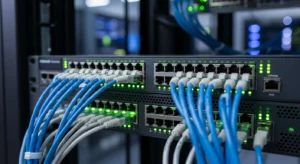
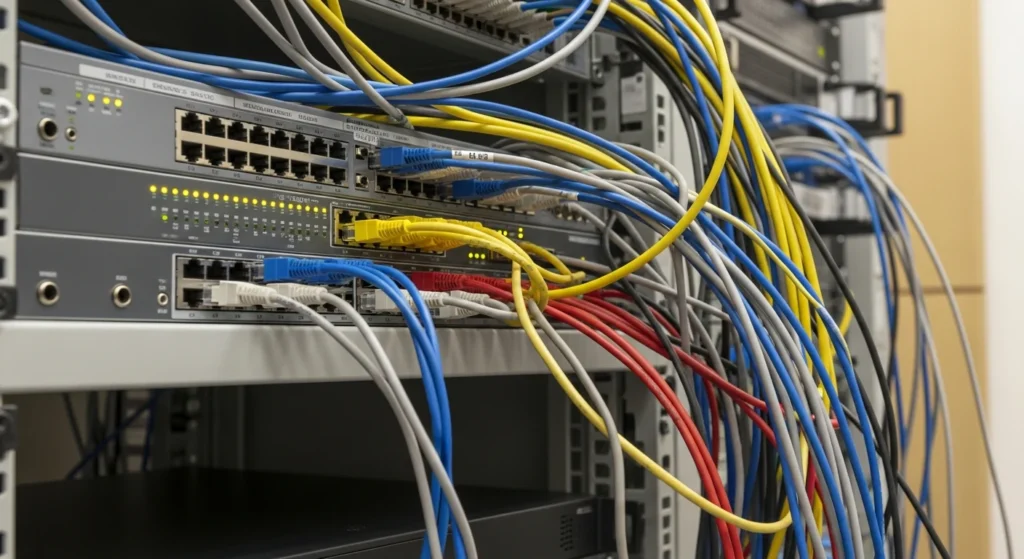
Most office switches mount inside a 19-inch equipment rack. A rackmount switch with a metal chassis provides better cooling, easier cable management, and a cleaner install. Patch panels mount above or below the switch. Short patch cords run from the panel to the switch ports. This is the cabling engineer’s standard.
Desktop switches are plastic, fanless, and sit on a shelf or desk. They are fine for a home office or a remote branch with two or three devices. For a structured cabling environment, avoid them. They lack proper airflow for dense PoE loads, they do not have mounting ears, and the ports face the front or back in ways that make patching messy. If you must use a desktop switch in a small IT closet, install a small wall-mounted rack and use a rackmount adapter.
Need Network Cabling in Toronto?
Free onsite survey within 48 hours. TIA-568 certified, Fluke DSX tested every run.
Power over Ethernet: sizing and heat
PoE is a major factor in switch selection. 802.3af (PoE) gives 15.4 W per port. 802.3at (PoE+) gives 30 W per port. 802.3bt (PoE++, Type 3) gives 60 W per port, and Type 4 reaches 90 W. Your cabling must match. Cat6 and Cat6A both handle PoE++ to 90 W within the 90 metre channel per TIA-568.2-D, but bundling cables raises temperature.
TIA TSB-184-A provides guidance on bundle size. For 24 cables carrying PoE+, bundle diameter should not exceed about 50 mm to keep temperature rise within 15°C above ambient. For PoE++, reduce bundle size further. Switch heat also matters. A 48-port PoE++ switch at full load can dissipate 300 W or more. The TR must have adequate cooling. A rackmount switch with side-to-side airflow is preferable to front-to-back in a narrow cabinet.
Check the switch PoE budget. A 48-port switch with a 760 W budget supports 24 ports at PoE+ and the rest at lower draw. You cannot power 48 cameras at 30 W each unless the budget exceeds 1440 W. Plan your power budget before you buy.
Future expansion: buy for the building, not the current headcount
Offices change. Partitions move. New functions appear. The cabling in the walls stays for 10 to 15 years. The switch may stay for five to seven years. Buy a switch that can handle the maximum port count your cable plant supports. If you terminated 192 ports in the TR, your first switch may be a 48-port unit, but plan for the second and third.
Managed switches with stacking capabilities let you interconnect multiple units via dedicated stacking ports or SFP+ cables at 40 GbE or 100 GbE aggregate. This creates a single logical switch with a unified management interface. That is cleaner than daisy-chaining uplinks. If you expect to grow beyond 96 ports, buy a stackable model from the start.
Practical rule: For an office with Cat6 or Cat6A cabling and more than 20 active ports, always choose a managed, rackmount switch with at least two 10 GbE SFP+ uplinks and a PoE budget that covers your known load plus 30 percent headroom.
A summary comparison for common office sizes
| Office size | Typical drops | Recommended switch | Uplink |
|---|---|---|---|
| Small office, 5-10 users | 10-20 | 24-port managed PoE+ | 1 GbE copper or SFP |
| Medium office, 30-60 users | 60-120 | (2) 48-port managed PoE+ stack | 10 GbE SFP+ per switch |
| Large office, 100+ users | 200-400 | (3+) 48-port managed PoE++ stack or chassis | 40/100 GbE fiber uplinks |
VLAN and QoS: the case for managed switches
VLANs are not optional in a modern office. Voice traffic should be on a separate VLAN with highest priority. Guest Wi-Fi should be isolated from the corporate LAN. Security cameras should not share a broadcast domain with workstations. A managed switch implements all of this with IEEE 802.1Q VLAN tagging.
QoS (IEEE 802.1p) lets the switch prioritize packets. Voice and video get queued ahead of file downloads. Without QoS, an email attachment can cause a phone call to drop. Modern unified communications systems like Microsoft Teams or Zoom rely on QoS at the switch level, not just the router.
An unmanaged switch cannot do VLANs or QoS. It treats all traffic equally. For a single flat network with no real-time applications, that is fine. For anything else, you need management.
Placement in the TR: cabling and power
The switch lives in the Telecommunications Room (TR) or the Main Distribution Frame (MDF). It mounts in a 19-inch rack above or below the patch panels. Never leave a switch on the floor. Floor placement collects dust, blocks airflow, and violates NEC cable support requirements.
Power the switch through a dedicated UPS. A managed switch with PoE draws significant current. A 48-port PoE+ switch at full load can pull 5 to 7 amps at 120 V. Do not share the circuit with other high-draw equipment. Install two separate circuits in the TR for redundancy if the budget allows.
Patch cords between the patch panel and the switch should be the shortest practical length, typically 1 to 3 feet. Use factory-made stranded patch cords, never solid cable. Solid cable in a patch cord violates TIA-568.2-D and cracks under repeated flexing.
Fiber backbone and switch compatibility
If your office spans multiple floors or buildings, the backbone between TRs is almost always fiber. OM3 multi-mode fiber supports 10GBASE-SR to 300 metres. OM4 reaches 400 metres. Single-mode fiber extends to kilometres. Your switch needs SFP+ cages that accept the corresponding transceiver modules.
Do not buy a switch that forces you to use copper uplinks between locations. Copper at 10 GbE is limited to 30 metres on Cat6A for 10GBASE-T, and 55 metres on Cat6 under some conditions. Fiber gives you distance, future upgrades to 25 GbE or 40 GbE, and electrical isolation between buildings.
Frequently Asked Questions
Planning a cabling project in the GTA?
Velocity Cabling designs and installs structured cabling, fiber, and security systems for businesses across Toronto, Mississauga, Brampton, and the surrounding area.