
Server Rack & Comms Room Installation in Toronto & the GTA
We build and clean up the rooms your network lives in: MDF and IDF closets, server racks and cabinets, patch panels, cable management, rack power and the paperwork that goes with them. New rooms, and existing ones that have grown out of control.
Velocity Cabling builds comms rooms and racks across Toronto and the GTA, from a single wall cabinet in a clinic to an MDF and five IDFs across a distribution centre in Caledon. A lot of the network problems we get called into start in this room: a closet nobody has labelled, a switch buried behind a wall of overlong patch cords, or an IDF placed where the copper runs end up past 100 metres. Fixing the room is usually cheaper than fixing everything downstream of it.
What We Build.
A comms room job covers more than bolting a rack to the floor. This is everything a full build from us includes. Existing rooms can take any part of it on its own.
| Part of the job | What we do |
|---|---|
| Room layout | Rack positions, working space, cable entry, power and cooling needs worked out before anything is mounted. On new builds the room is sized with your general contractor. |
| Racks and cabinets | Two-post and four-post open racks, floor-standing cabinets and wall-mount cabinets, supplied, assembled, anchored and levelled. |
| Pathway into the room | Overhead ladder rack and basket tray from the ceiling space down to the racks, sized to 40 percent fill so there is room to add cable later. |
| Panels and cable management | Copper and fiber patch panels, horizontal managers between panels and switches, vertical managers on open racks. Bundles dressed with hook-and-loop ties, not over-tightened zip ties. |
| Equipment | Your switches, firewalls, NVRs and UPS units mounted, powered and patched to your port map. |
| Labelling | Panels, ports and both ends of every cord labelled to TIA-606, matched to a written patch panel schedule. |
| Testing | Every copper link certified on a Fluke DSX, fiber loss tested on every strand, with OTDR traces where the job calls for them. |
If the floor still needs cabling as well, the room and the horizontal runs are usually one project. See our network cabling page for the cable side.
Choosing The Rack.
The right enclosure depends on the room, the equipment and who else has a key. These are the five we install most, and the thing to watch with each.
| Type | Where it fits | Watch for |
|---|---|---|
| Two-post open rack | Dedicated, locked comms rooms and IDFs that hold mostly patch panels and switches. | Too shallow for most servers. Has to be anchored to the floor. |
| Four-post open rack | Rooms with servers, storage or a heavy UPS that needs support at the back. | Takes more floor space and offers no security on its own. |
| Floor-standing cabinet | Shared rooms, warehouse floors and offices where equipment needs a locked door or dust protection. | Heat builds up without proper venting. Check the depth against your deepest device. |
| Wall-mount cabinet | Small offices, retail and branch sites, and closets with no floor space. | All the weight hangs on the wall, and depth is limited. |
| Swing-out wall cabinet | Wall installs where you still need to reach the back of the equipment. | Needs clear swing space beside it. |
Racks are measured in rack units: one unit is 1.75 inches, and a full-height 42U rack stands a little over two metres. Depth matters as much as height. Switches and patch panels are shallow, but servers and many UPS units need a deep four-post rack or cabinet with rails front and back. We list every device before choosing, and leave free space for what you will add over the next few years. Our guide to small business rack design shows the order equipment usually goes in, top to bottom.
Office Comms Rooms And Closets.
Too small, too hot, or both
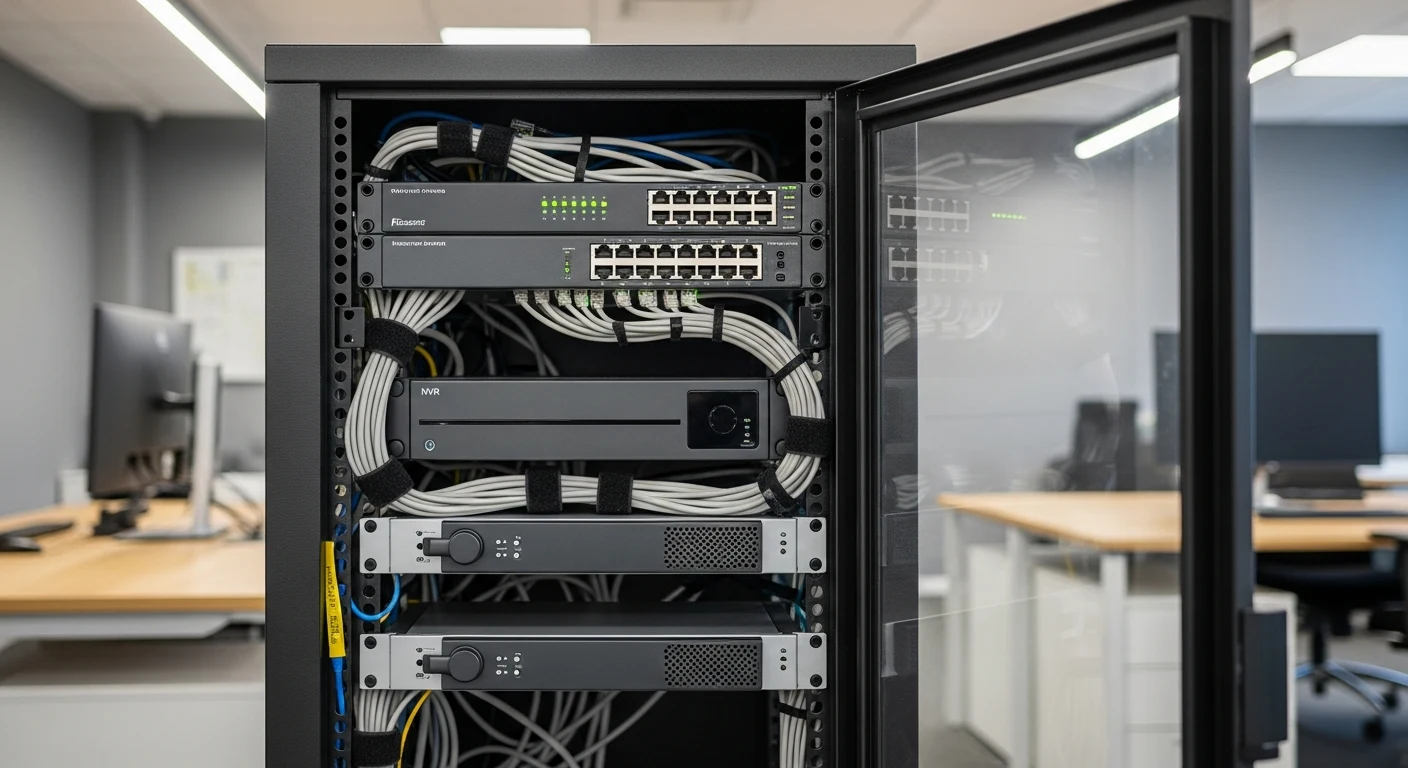
Office comms closets are usually whatever room was left over when the floor plan was drawn. A modern PoE switch powering cameras, phones and access points puts out real heat, and a closed closet with no ventilation cooks it. When a room needs cooling we tell you before the equipment goes in, so your HVAC contractor can deal with it as part of the fit-out instead of after the first summer failure.
Shared closets
Network gear often ends up sharing space with electrical panels, a janitor's sink or building storage. Electrical panels need clear working space in front of them that a rack must never block, and water pipes running overhead are a risk to anything below. We lay the room out around those constraints, and tell you plainly when the closet is the wrong place for the network.
Wall cabinets need something solid behind them
A loaded wall cabinet with a switch, a patch panel and a small UPS is heavier than most people expect. We mount wall cabinets to a plywood backboard or into the studs, never on drywall anchors alone. For the cabling that feeds the closet, see our office cabling page.
Warehouse MDF And IDFs.
In a large building the number and position of network closets is set by one rule: a copper channel tops out at 100 metres. Put the IDFs in the wrong place and the far corners of the floor end up out of reach, or every run gets routed the long way round. We plan IDF positions from the floor drawings and the routes the cable will actually take, then link each IDF back to the MDF over a fiber backbone.
On an open warehouse floor, IDFs go into lockable cabinets with filtered ventilation to keep dust and debris out of the switches.
Cabinets are positioned away from forklift routes, or protected where the layout leaves no other choice.
Scanners, Wi-Fi and cameras all depend on the IDF switches. A UPS in each IDF keeps them up through short outages.

Maersk Distribution Centre, Caledon. We built the MDF on a two-post rack with the service runs from the building's demarcation point, then placed five IDF cabinets around the building so every copper run stays within 100 metres. Each IDF connects back to the MDF over OM3 fiber. Maersk supplied the switches and UPS units, and we mounted them and patched them to their port map. Their IT team works remotely, so we photographed every cabinet after install. We still handle their adds and moves. Read the Maersk project.
Shared Buildings And New Builds.
Getting service from the demarc to your suite
In a multi-tenant building, carrier services land at the building's demarcation point, often in a basement telecom room. Getting them up the riser to your suite needs the landlord's approval, access to the riser, and a pathway that respects the fire separations between floors. We run that extension and coordinate with the property manager and the carrier, so your MDF has its service on day one.
New builds: get involved before the walls close
The cheapest comms room is the one planned on the drawings. Room size, door swing, wall sleeves, the backboard, dedicated circuits, cooling and the overhead ladder rack are all easy to get right before drywall and ceilings go in, and expensive afterwards. We work from the drawings with your general contractor and rough in the cable tray and ladder rack at the right stage of the build.
Network Rack Cleanup.
Most messy racks were tidy once. Years of moves and quick fixes later, nobody can say which cord goes where, the switch fans are buried behind a curtain of patch cords, and replacing a single switch has turned into a weekend job. A cleanup puts the rack back into a state your IT team can work in, without ripping out what already works.
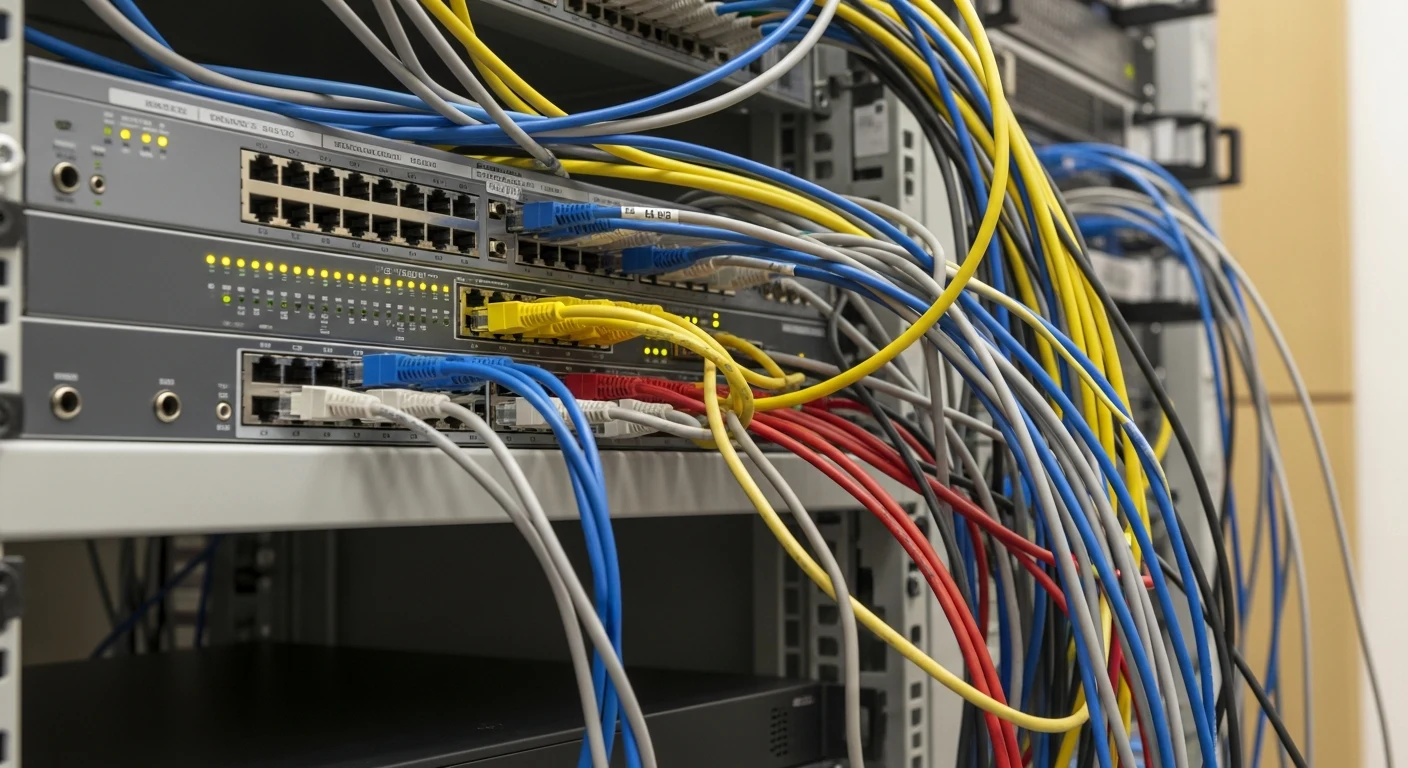
| Problem | Before | After |
|---|---|---|
| Patch cords | Overlong, mixed colours, draped over the switches | Cut-to-length cords, colour coded by function |
| Labels | Missing, handwritten or wrong | Printed labels on both ends and every port, matched to the schedule |
| Port map | Lives in one person's head | As-left port map and rack elevation handed over |
| Dead cable | Abandoned runs and old phone wiring in the way | Traced, confirmed unused and removed |
| Airflow | Cord bundles covering switch vents and fans | Cords routed through managers so equipment can breathe |
| Bad terminations | Intermittent ports nobody can explain | Re-terminated and certified on the Fluke DSX |
Re-patching a live network
A cleanup is only safe if it can be undone. Before any cord moves we photograph the rack and build an as-found port map, using a port and VLAN export from your switches that your IT team or provider pulls for us. New cords are cut to length in advance. The work happens after hours or on a weekend, one switch at a time, and we confirm each device reconnects before moving to the next. If anything behaves differently, the as-found map tells us exactly where it was.
Where a rack is past saving, with no managers, no room to add them, or panels that were never terminated properly, we will say so and price a rebuild alongside the cleanup, so you can choose.

Power, UPS And Grounding.
Rack power is where low voltage meets the electrical trade, so the split matters. We mount and connect rack power strips and UPS units. Any new circuits, receptacles or panel work for the room are done by a licensed electrical contractor, scheduled with our work through our commercial electrical service.
Basic strips just distribute power. Metered strips show the load so you know how close the circuit is to its limit. Switched strips let your IT team reboot a device remotely.
The UPS is usually the heaviest item in the rack, so it goes at the bottom. Runtime is sized to the load and to what has to stay up during an outage.
Racks and cabinets are bonded to the building's telecommunications ground. Where the room has no grounding busbar, the electrical contractor installs one.
What You Get At Handover.
A tidy rack stays tidy only if the next person can see how it was built. Every build and every cleanup ends with the same documentation set.
What Drives The Cost.
Every job gets an itemized written price after a site visit, before any work starts. These are the things that move the number.
An empty room on a new build is the simplest case. A live room that has to keep running while we work takes more planning and after-hours time.
Open racks cost less than cabinets. Deep cabinets for servers cost more than wall-mount units for a small closet.
Ladder rack, basket tray and wall sleeves add material and labour, especially in finished ceilings.
Port count matters, but how undocumented the rack is matters more. Tracing unknown runs is the slow part.
New circuits, a larger UPS or metered power strips add to the scope. Circuits are priced by the licensed electrical contractor.
The volume of abandoned cable to trace and remove can be a small line item or a large one, depending on the building's history.
Get a fixed price for your room.
We look at the room, the racks, the pathway and the power, then send an itemized quote. Site visits are booked within 48 hours.
Rack And Comms Room Questions.
Yes. Cleanups are done after hours or on a weekend, one switch at a time. Each device is offline only for the few seconds it takes to move its patch cord, and we confirm it reconnects before moving to the next one. We work from an as-found port map, so anything we touch can be put back exactly as it was.
Read access helps, or your IT team or provider can export the port and VLAN map for us. We use it to build the as-found map before anything moves. We do not change switch configuration unless your IT team asks us to.
Open two-post racks suit dedicated, locked comms rooms. They cost less, are easier to patch and shed heat well. Enclosed cabinets suit shared spaces, warehouse floors and offices where the equipment needs a locked door, dust protection or quieter operation. Wall-mount cabinets suit small closets with no floor space.
It depends on how many racks it holds and what goes in them. Each rack needs clear working space in front and enough room behind to reach the back of the equipment, and the room should not double as a storage or janitor's closet. On new builds we size the room with your general contractor before the walls go up, because adding space later is the expensive option.
Yes. We label and document every connection before anything is unplugged, rebuild the rack at the new site, and patch it back to the same port map so your IT team is not starting from scratch. Moves and changes are routine work for us.
Yes, where it is agreed and safe. Dead runs are traced and confirmed unused before they come out, so nothing live gets cut. Taking them out frees space in the pathway and lets the rack breathe.
We mount and connect rack power strips and UPS units. New dedicated circuits or receptacles for the room are installed by a licensed electrical contractor working on the same schedule, so you are not coordinating two separate trades.
Toronto, Mississauga, Brampton, Caledon, Vaughan, Markham, Scarborough, Etobicoke, Oakville, Hamilton, Kitchener-Waterloo, Guelph, Whitby, Pickering and Ajax. Larger multi-site jobs elsewhere in Southern Ontario are quoted case by case.
Toronto, The GTA & Southern Ontario.
Crews dispatch from our Toronto base and reach most GTA sites within an hour.

Book A Site Visit. Get A Fixed Price.
Comms rooms, server racks and network cleanups across Toronto and the GTA. Site visit booked within 48 hours, itemized price before we start.
Mon–Fri 8am–10pm · Evening & weekend installs available · Toronto, GTA & Southern Ontario